Modern HVAC: The Cost-Effective and Healthy Choice
Most schools rely on “legacy” HVAC systems, such as steam generation and fossil-fuel-burning boilers, to produce heat. These inefficient systems waste energy, straining school budgets as energy costs climb. They also release harmful particulates and gases contributing to unhealthy air and exacerbating dangerous leaks.
Choosing the right HVAC system has financial but also health, safety, and learning implications.
School districts are leveraging federal energy tax credits as a noncompetitive, durable funding source for a modern HVAC solution with a proven track record.
Modern HVAC systems are highly efficient because instead of making heat, they move it. For example, ground-source heat pumps (or geothermal) move heat that exists underground. They often require less maintenance, operate reliably in extreme temperatures, do not release unsafe pollutants, and improve indoor air quality.
When planning new construction, renovation, or HVAC replacement projects, school business officials should ensure ground-source heat pumps are considered. Thanks to the federal energy tax credit, this technology can be the most affordable option for installation. Given their high efficiency, they are likely to generate substantial operating cost savings.
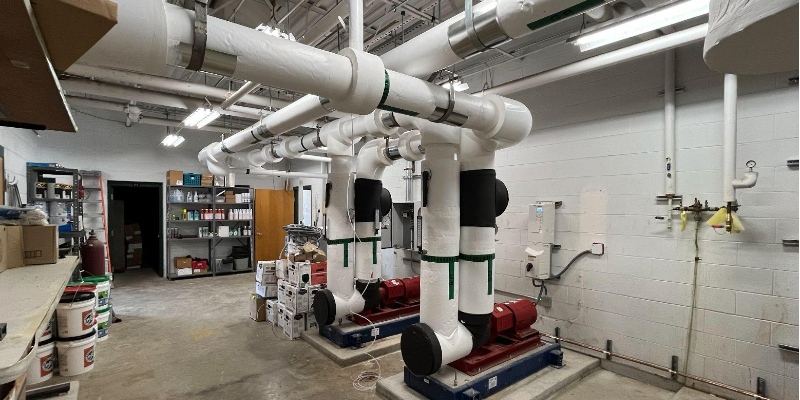 Ground-source heat pump system at Rupert Elementary and Western Greenbrier Middle School in Greenbrier County Schools (WV). (Courtesy of Western Greenbrier Middle School Yearbook Staff)
Federal Energy Tax Credits: Unlock Savings
In 2022, Menasha Joint School District in Wisconsin began planning a new middle school. They selected ground-source heat pumps as their HVAC system due to their efficiency and support of healthy, safe learning environments. During the planning process, Brian Adesso, director of business services, learned the district could earn federal energy tax credits for this choice.
Reimbursements are typically around 30% of the eligible energy property costs but can be up to 50%. This funding is available for all schools through 2034. After projects are completed, districts file with the IRS. The IRS processes these filings and issues checks. These funds are treated as cash to the district.
When asked what motivated the district and project team to pursue the credit, Adesso shared, “The biggest thing that got people moving was understanding what was at stake here: millions of dollars, not ten thousand dollars, and not just the future savings in energy costs.”
The district filed with the IRS in April 2026 and in May received a check for over $5.3 million, $4 million of which was for the ground-source heat pump system.
 Adesso with Menasha Joint School District’s (WI) check. (Courtesy of Brian Adesso, Menasha Joint School District)
Drive Dollars to Your District
Districts have the opportunity to think strategically about how to make the most of this unlimited, noncompetitive federal funding for HVAC improvements, which has been available for nearly a decade. Where should districts start?
-
Level up project teams. School business officers can bring this funding opportunity into facilities and capital planning discussions. Share this one-pager with district leaders, project teams, and communities. Bring this information to the table early to ensure project planning accounts for tax credit requirements and that dollars are not missed.
-
Connect with peers. Schools can benefit from learning from each other’s experiences. Dive deep into two school modernization projects from Connecticut and Michigan that successfully modernized their aging buildings, incorporating ground-source heat pumps and received the tax credit. These case studies discuss how the districts strategically layered funding sources to make projects happen.
-
Prepare for success. Your district may already be considering or pursuing ground-source heat pumps. School business leaders should be aware of the tax credit. Use this guide for an overview of how to earn and maximize these funds, an explanation of key concepts, requirements, and processes, and examples of schools that have received checks.
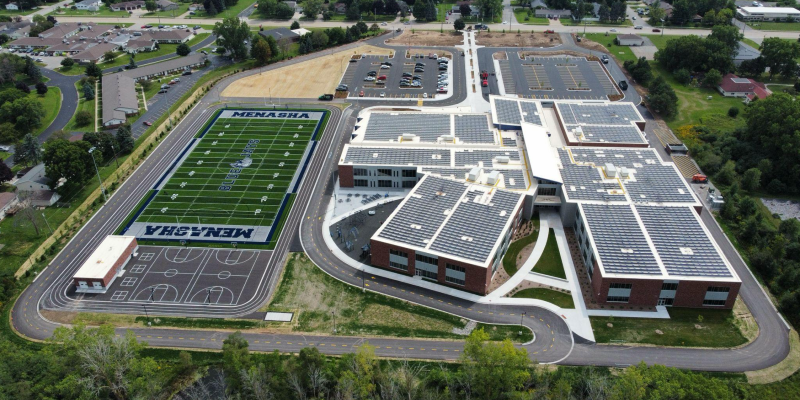 Aerial view of Maplewood Middle School, a net-zero middle school in Menasha Joint School District (WI) that incorporates ground-source heat pumps, a solar energy system, and battery energy storage. (Courtesy of Brian Adesso, Menasha Joint School District)
Modern HVAC systems are essential for student health. With a game-changing funding source for ground-source heat pumps, districts can’t afford to miss these benefits — and school business officers can make sure they don’t.