Effective leadership in the school kitchen includes bringing accountability to these teams despite their differences. School kitchen staff often operate on tribal knowledge—a collective wisdom that’s known only within a group—and getting cooks to think differently and embrace change can be difficult.
One way to help staff overcome differences and eliminate silos is by implementing production schedules in kitchens. Staff are challenged to accomplish tasks within certain timeframes. The schedules dictate specific time blocks in which staff should come together and work as one, which naturally builds teamwork. Over time, they recognize that they can achieve the work more efficiently by supporting each other and working in groups.
Being challenged to achieve specific tasks by specific deadlines also ensures that cooks are held accountable for their responsibilities.
Essential Tenets of Leadership
Communication and true efficiency won’t flourish in silos. Thus, it is crucial for cooks who want to work faster—and smarter—to learn how to work together in new ways. Four essential tenets of leadership can break down those silos and promote communication and efficiency.
1. Start with a Vision
Leaders must have a vision for individuals on the team and for the program they’re taking on. They must communicate this vision to the entire team, so every staff member sees the goal as bigger than themselves.
For instance, cooks might realize that in addition to serving customers, they ultimately are helping the local economy through the work they do. An effective leader not only sees that potential but motivates the cooks by reminding them of it regularly.
Some leaders may have a vision but get lost in the “how” and become discouraged. How exactly are they going to get from Point A to Point B? The key is to not worry so much about the “how” but to instead focus on the goal. With a strong vision, leaders will find a way there.
2. Communicate Across All Levels
Talking with staff at every level of the organization can uncover valuable and often hidden information. Too often, upper management isn’t engaging with the on-the-ground staff who have crucial knowledge about day-to-day operations. It is not uncommon for front-line kitchen staff to know exactly how much waste their organization is creating, for example, while the CFO does not.
Although personnel issues tend to be common in school kitchens, kitchen management might be disinclined to report staff issues to school or district leaders for fear that it will reflect poorly on their own leadership abilities. With this understanding, leaders must create space for this kind of communication, which sets a positive example and trickles down to all levels of staff.
3. Set Priorities
Priorities are more important than timelines. Without priorities, managers can lose sight of their goals and compromise where they shouldn’t. Too many leaders who want to embrace healthy cooking fall short because they don’t have the right priorities in place. When budgets are slashed and departments are forced to cut corners, they decide to purchase canned or other processed foods instead of investing in the locally sourced, scratch-cooked foods they as they had planned because ultimately, they didn’t make student health the priority.
4. Use Data to Visualize the Big Picture
It’s easy for kitchen teams to become overwhelmed in the moment, especially during stressful production periods. That’s why it’s important to help teams remember where they started, where they’re going, and why they’re on this difficult journey in the first place. Get staff together and remind them that their hard work matters: Serving students and staff healthy food ultimately helps the community combat declining levels of health and therefore improves quality of life.This macro view—“Remember when we started with shredded iceberg lettuce, and now we’re serving fresh local salads?” for example—can motivate teams when they most need it.
By tracking data such as how much fresh food schools use, how much of it is local, the costs involved, etc., on a monthly basis helps kitchen staff see how far they have come.
Four essential tenets of leadership can break down those silos and promote communication and efficiency
Success Stories
Westminster Community Charter School, a K-8 school in Buffalo, New York, built a sustainable food program that reduced the school's average food cost by 15% in 2016. It also kept more than 75% of the school’s food waste from landfills. That year, Westminster kitchen staff cooked from scratch 60% of the breakfasts, 80% of the afternoon snacks, and 100% of the lunches.
With more students eating Westminster’s food every day, Westminster was able to capitalize on economies of scale. Thanks to staff leadership in their kitchen, they were able to scratch cook more meals each day, which helped them buy certain ingredients in bulk and save money.
Nardin Academy (also in Buffalo) put leadership in place that enabled it to set up a waste tracking system for recycling, compost, and landfill waste. The result: Nardin diverted 86% of its cafeteria waste during the school year.
This reduction in waste, as well as a more efficient kitchen, made it possible for Nardin to buy higher quality food and green products. The school went from buying 80% processed foods (with half of its sales coming from snacks and beverages) to a menu made entirely from scratch, with 74% of sales coming from well-balanced meals.
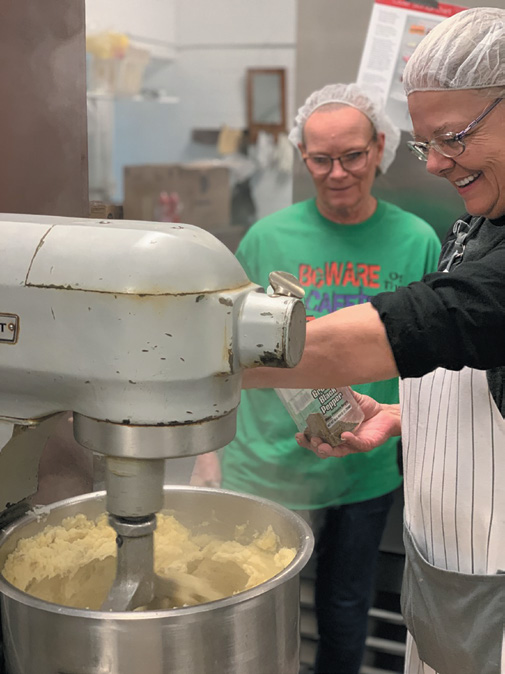 Effective leadership can transform the school cafeteria program.
Kitchen staff in multiple Lincoln, Illinois, schools, a city with one of the highest obesity levels in the state, is being trained to meet similar goals. Some of the head cooks say they had to learn to delegate and “be bossy,” but the leadership has paid off in foundational health changes for their students and community.
Embracing Change
Strong leadership is always critical to success, but even more so during change, when emotions run high. Through accountable leadership, any group can move from operating on tribal knowledge to embracing fruitful change.