School business officials (SBOs) are generally proficient at presenting numbers in nicely formatted and precise spreadsheets. They know the numbers well, but they often forget that the numbers represent new information to their audience. When data are presented with context, a purpose, and a proposed outcome in a way that is relevant, timely, and easily understood, they are more than just charts full of numbers; the data tell the district’s story.
Telling a story with data can yield impressive results; using data to tell the right story has power to persuade and convince. Let’s look at how data can be used effectively with key stakeholders in the negotiations process.
Framing the Process for the Board
School business professionals should remember that board members typically are not as well versed in school business; they do not work with the structures and systems that are unique to the school district environment.
SBOs should ensure the board members have a strong grasp of the negotiations process, including legal timelines, past practices in the district, the board’s role in the process, and the process with regard to the staff. It is also important to provide a brief overview of the employee contract or agreement—how it is structured, important components of the agreement, current issues that must be addressed through changes to contract language, and the like.
For example, board members should understand how teachers are placed on the salary schedule, how they move within that schedule each year, and their ability to move across the schedule as they attain additional university credits or degrees. The board may not like the structure, but they should understand it as the district enters negotiations.
Answers to three major questions can help the board better understand the district’s negotiating process:
- What is our market?
- Where are we in the market?
- Where do we want to be in the market?
Discussing these questions early in the negotiation process provides a solid base and specific parameters to ensure that the process has a clear road map informed by data and reasonable expectations. It also helps the board understand that decisions regarding salary and benefits can affect the school system’s ability to attract and retain quality talent.
- What is our market?
With whom does the district compete to attract and retain quality staff members? The education industry is relatively unique; it is difficult to compare salaries of the professional teaching staff with those of personnel in other organizations and companies in the community. Commonalities in salary, benefits, and working conditions are limited, so comparisons should be made with similar school districts.
Similar districts can be identified using such factors as percentage of students from low-income families, total student enrollment, and budget size.
- Where are we in the market?
Where is the district positioned in the identified market with regard to compensation? How does the district compare with competitors with regard to maximum salary on the scale? How many years does it take to reach the maximum? How much do employees contribute to health insurance compared with the district’s peer group? How many workdays are in the year? How does the teacher starting salary compare with the peer districts?
Data plays a significant role in answering these questions. Depending on the negotiation’s time frame and length of agreement, SBOs may need to reexamine benchmark data throughout the process. It may be necessary to benchmark impacts and changes proposed in the negotiations or by the established peer district. Ensuring that benchmark data can be updated easily and presented in different scenarios is key to supporting the entire negotiations process.
Figure 1 illustrates one district’s position with regard to professional salaries relative to its peer group. The highlighted dots are the district’s salaries. The line is the average for that peer group. As the chart indicates, this district offers salaries that are higher than those of other districts in their market.
- Where do we want to be in the market?
The next step is to determine where the district wants to be positioned within the market. If the district falls at the bottom of the peer group in starting salaries and wants to be in the middle of the pack, that desire informs the negotiation strategy. If the district is at the top in maximum salary and wants to be in the middle, the district must hold the line at the maximum step when negotiating.
Another factor that districts must consider is their ability to attract qualified and top-notch people for open positions. What is the turnover rate like? Educating the board on these factors is important. Correlating return on investment in personnel costs to academic performance is also an important consideration in establishing contractual terms.
Overall Financial State
After SBOs set a baseline relative to the marketplace, it is time to educate the board about the overall financial state of the district. They can develop attractive and easy-to-read charts to reflect the following information:
- Five-year financial projections based on certain assumptions
- History of salary and benefit increases
- History and projection of fund balance(s)
- Cost impact of “status quo”—moving staff members on the salary schedule (without changing the values) and the projected costs of benefits (without making any changes)
- Revenue sources—how reliant is the budget on local tax sources, how much state and federal subsidy is received per student (current and historical)
- Student–teacher staffing ratios
Providing this information will help determine what the district can afford and what the impact and implications will be to any proposed changes and eventual settlement of a contract. Figure 2 offers an example of a dashboard that provides summary information for projected revenues, expenditures, and fund balances.
Educating the Staff
Much of the same data that are shared with the board should be shared with the employee group with whom the district is negotiating, although the approach may be slightly different. Even though the staff members work in the district, they are typically unfamiliar with its financial affairs beyond hearing “We can’t afford that,” “Costs continue to escalate out of control,” “We are getting less funding,” “The cost of status quo health insurance is unaffordable,” or “The community will not accept another tax increase.”
If these statements are true, SBOs should help staff members understand why by:
- Reviewing the budget impact of strategic initiatives and goals related to additional technology and improved facilities.
- Translating the planned programs and projects into dollars and show the impact on an already-stressed budget.
- Providing an overview and general sense of the community. Most staff members’ interactions are largely with parents, and the parents’ perspectives about salary and benefits may be very different from the perspective of the community at large.
- Educating staff on the total cost of employment. When individuals show up to the negotiating table, they are thinking of their own position and net salary or perhaps that of a colleague who has expressed displeasure. They are not thinking of the bigger picture: the total cost to the district. Show them the total cost of salaries and benefits relative to the overall budget.
- Helping staff understand that the fund balance is similar to a savings account, and if the funds are spent on recurring expenses and the balance is spent down, it creates a catastrophic situation.
The fund balance can be a contentious subject at the negotiating table. Employees see it as cash to be spent on their salaries; management tries to protect it at all cost. Because the amount of the fund balance is typically public information, staff (and the community) know the amount, and it might seem excessive to them. SBOs should put it in perspective as a percentage of the total budget and illustrate how the fund has been used effectively in the past.
If the district is contemplating borrowing or has current debt outstanding, SBOs should help staff understand how the bond rating is affected by the amount of a district’s fund balance— the better the rating the less interest cost the district will incur.
Explaining the complex and challenging world of school finance takes time and effort, but it is worth it. Staff may not welcome the information or agree with all of its aspects, but if they understand it, the district is one step ahead. Charts and graphs will help them understand and appreciate how decisions made for the contract years being negotiated will affect them and the district for many years down the road. It’s all about telling the story and building trust.
SBOs who have time outside the negotiations process can use public meetings and online data dashboards to provide regular updates on key performance indicators and other financial benchmarks. Some districts regularly update comprehensive data points on financial and academic performance.
Providing information, communicating effectively, and being transparent go a long way toward building trust with all parties involved, which is critical to effective negotiations.
Educating the Community
Educating the community at large is challenging; too much or too little information can be toxic. The right amount of information provided without proper context is just as deadly. Again, user-friendly charts and graphs can be valuable resources. A limited amount of narrative will help the user understand the salient information in the charts.
SBOs should ensure that the focus is on the reason for and value of spending dollars on education. They should remind community members that what happens in the classroom is critical to the success of both the educational program and the students, and a key element of the classroom is the professional staff. To attract and retain quality staff members, the salary, benefits, and working conditions must be commensurate with the talent the district is trying to hire and keep.
It’s beneficial to provide information about the accomplishments of the professional staff. Show the success the district has had from a student achievement standpoint. Highlight the purpose for the money the district spends to maintain the focus on education. Keep the message as positive as possible to avoid negative and destructive attitudes and behavior.
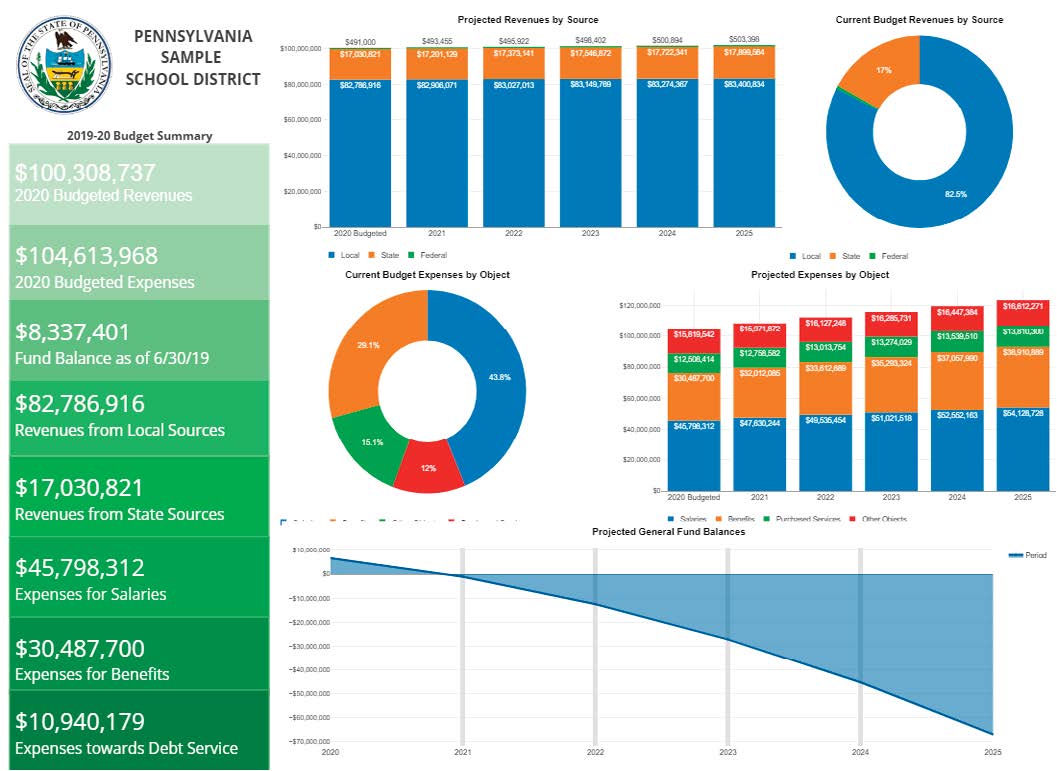 Figure 2. Projected General Fund Finances at a Glance, Pennsylvania sample school district
The Bottom Line
The goal of negotiations is to create (or further develop) a trusting relationship between the employee groups, the administration, the board of directors, and the community. That is not an easy task, which takes time and effort; the trust relationship must be developed long before the start of negotiations.
Providing masses of information and data at the onset of negotiations does not give adequate time for comprehension; however, if SBOs haven’t done the work ahead of time, it is still prudent to make data and information available at the start of the negotiation process.
Develop standard templates for the information, have a systematic and organized approach to the data, and present the material in an attractive, simple, easy-to-understand format. Always tell a story with your data. A simple data dump will not work. Trust us.