Maybe that’s why many of us can relate to sustainability education—it places students in the forefront of saving the planet. Visionary administrators, activist parents, and crusading students are pressing school boards to address environmental concerns by adding sustainability employees to district payrolls.
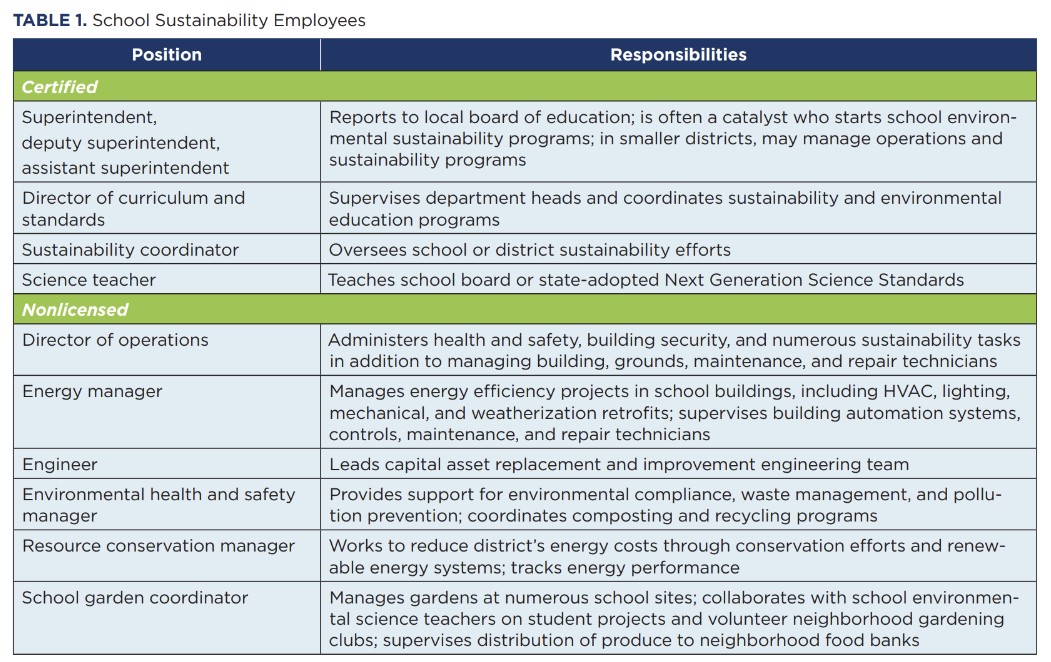
Table 1 identifies some of the sustainability employees in today’s schools. The list includes long-standing certified and nonlicensed staff positions that have been tasked with additional responsibilities related to sustainability. Successful school environmental sustainability programs depend on two additional classes of individuals: contract workers and parent volunteers.
Here are some strategies for increasing sustainability education in your district by focusing on personnel.
Appoint a Sustainability Coordinator
Sustainability coordinator is currently the preferred title for many certified and nonlicensed sustainability personnel. A science teacher may be offered a stipend to function as sustainability coordinator in addition to performing regular classroom duties.
Every school in Fayette County Public Schools in Lexington, Kentucky—all 56 of them—has a sustainability coordinator. New York City Public Schools has adopted the same model.
The science teacher at P.S. 333, Manhattan School for Children, and her counterpart at Rosa Parks Elementary School in Lexington are site coordinators responsible for facilitating their schools’ sustainability initiatives and managing the “Green Teams,” which include students, parents, and community partners.
The coordinators monitor the schools’ compost, recycling, and wellness plans in addition to writing grant proposals. They ensure that their custodial staffs are engaged and supportive of recycling and energy efficiency (e.g., turning off lights) and have an active part in planning school events to promote sustainability and wellness, such as Arts and Science Day and Earth Week.
As K–8 classroom science teachers, supervised by their principals, they guide students in presenting year-end projects based on protecting the planet; they also participate in the “Adopt-a-Tree” and “Farm to School” programs.
Alternatively, many districts have opted to hire one sustainability coordinator to work with all their schools, reporting to the director of operations. The coordinators view their mission as promoting the three pillars of sustainability: environmental literacy, building efficiency, and student wellness.
As district employees, they establish and maintain effective working relationships with a variety of stakeholders, administrators, consultants, government officials, nonprofit representatives, and community partners. The coordinators are responsible for developing and updating five-year sustainability plans, including managing all projects associated with the plans. They manage the schools’ behavior-based energy conservation programs, conduct energy waste audits, provide guidance and training for new programs, and recommend curriculum resources and grant opportunities. Coordinators design and maintain the Green Team website and other social media communication.
Although many coordinators may not be certified personnel, this is not to infer they are not professionals. Their diverse backgrounds might include graduate degrees and work as a county extension educational coordinator.
Expand the Operations Department
Using effective cost–benefit analysis, school business officials have been able to demonstrate how key positions not only can pay for themselves but also can produce considerable savings for their districts. As a result, school districts have expanded or established new positions in their operations departments.
Smaller districts with modest means have created the energy manager position to augment the operations director’s duties. In larger districts, the responsibilities warrant hiring resource conservation managers and environmental health and safety managers. Qualifications for these jobs vary, with some personnel holding advanced engineering or environmental science degrees.
Energy managers work to reduce the district’s energy costs by targeted efficiency projects, including heating, ventilating, and air-conditioning (HVAC); lighting; mechanical; and weatherization retrofits. They plan renewable energy systems, such as solar energy; establish energy-purchasing partnerships with regional educational collaboratives, such as New York’s Boards of Cooperative Educational Services; and ensure that districts receive energy-saving grants and rebates from utility providers. They oversee energy, water, and waste contracts and provide billing analysis for the district procurement officer.
Building resource-monitoring systems have provided simplified energy use data for reporting by the energy manager. The programs are installed in school buildings with sensors attached to HVAC units or water, gas, electricity, and solar energy panels. Reports can be generated in real time to alert managers to malfunctioning systems and current energy consumption.
The director of operations should be expected to establish proficiency goals for energy, conservation, health, and safety managers. Realistic expectations include the managers’ reduction of energy consumption by 15% at the end of their first year of employment. A similar goal could be established for reducing water usage by 15%; a higher expectation might be established for reducing, reusing, recycling, and composting waste by perhaps 20%.
Recruit Sustainability Personnel
With the encouragement of school business officials, districts can ensure that the mending process continues by recruiting trained and experienced sustainability personnel. The three pillars of sustainability—environmental literacy, building efficiency, and student wellness—can be linked to every line item in a school’s operating budget.