Frequent Demographic Studies
Many fluid factors affect district growth, including unemployment, the housing market, construction costs, and economic development. I firmly believe in the “measure twice and cut once” approach; so to help plan for growth, we hire a consultant to conduct frequent demographic studies. We owe it to our stakeholders to enlist the services of professionals in this regard and to revisit those findings frequently to ensure that we are making informed decisions when it comes to investing in new schools.
Wentzville’s most recent demographic study—completed last year as part of a process to develop new boundaries for elementary, middle, and high schools—indicates that growth has no end in sight; we might add 5,000 students over the next decade. We are currently the ninth-largest district in the state, and at this rate, we could potentially be the third-largest district by 2030.
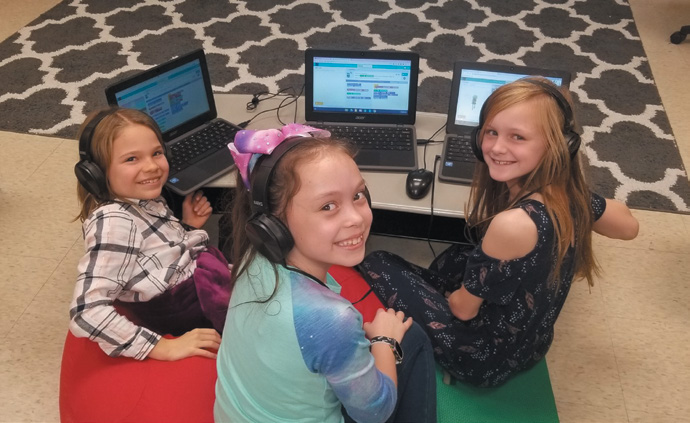 Students at Boone Trail Elementary learn coding.
Land Acquisition
Always strategic in its acquisition of land for future school sites, the WSD purchased three tracts in the far western portion of the district years ago. Lack of access to utilities has prevented their use for schools; however, as growth continues to move from east to west and the infrastructure precedes that growth, they will be valuable parcels for additional schools. In the meantime, the sites are leased to farmers as a source of revenue for the district.
A realtor is helping the WSD identify available land and negotiate fair prices per acre for suitable parcels. The last four land transactions have resulted in purchase prices well below the appraised value—an important point of pride that resonates with stakeholders.
As we continue to seek additional building sites, however, we are competing with home builders and developers for that remaining open space. Consequently, finding suitable sites at a reasonable cost that are large enough for even an elementary school—not to mention a middle or high school—is increasingly problematic. We were fortunate to secure 109 acres for a new high school and potentially a middle school as well.
Creative Solutions
The district has had to be creative at times in how it used space in facilities. When Proposition E—which asked voters to approve a tax levy increase to help the district accommodate enrollment growth—failed in November 2014, the challenge was how to accommodate students enrolled at Discovery Ridge Elementary School the following school year.
Classroom space, however, was available at Frontier Middle School, which is around the corner from Discovery Ridge. So a one-year solution made sense for students who would be attending that school the following year for sixth grade; fifth grade students from Discovery Ridge Elementary were moved to Frontier Middle School for the 2015/16 school year.
Creative solutions are possible only when you are open and transparent about the need and you have flexible and supportive staff and families who come together to make it work.
Proposition E passed in 2015, providing funding for a new elementary school, phase 2 of Liberty High School, additions at four schools, and renovations at Wentzville Middle School. The district had a pressing need for a new middle school as well and recognized it was pushing the envelope with the support of our stakeholders; even some of our staunchest advocates were suffering from voter fatigue. After all, between 1989 and 2015, the district had 26 ballot initiatives in 26 years.
The board of education held two work sessions in June and August 2015 to discuss how to address the middle school capacity problem without returning to the voters for a tax increase. Options included operating schools year-round, splitting shifts, or moving sixth grade from the middle schools to the elementary schools.
The board ultimately decided to move forward with the K–6 Plan for Growth: using cash reserves and borrowed funds to build an additional elementary school (Wabash Elementary) and the elementary approved by voters that April (Stone Creek Elementary) simultaneously and moving sixth grade out of the three middle schools to alleviate crowding without having to return to voters.
The K–6 Plan for Growth also gave the district time to pay down debt so that the next ballot initiative for new schools could be accomplished without increasing the tax levy.
The K–6 Plan for Growth also gave the district time to pay down debt so that the next ballot initiative for new schools could be accomplished without increasing the tax levy. That goal was achieved when the district placed Proposition E 2018 on the ballot, a no-tax-increase bond issue passed by voters that resulted in $125 million to build the district’s fourth high school, a 13th elementary school, additions at three schools, and a new gymnasium at Holt High School.
 Advertising opportunities for businesses, including displaying signs in high school gymnasiums, has proved a good source of revenue for the district.
Financial Stewardship
A history of clean audits and fiscal responsibility across the district has resulted in a strong Aa2 credit rating through Moody’s, one of the highest ratings for any school district in Missouri. This rating provides the district with multiple opportunities to refinance debt and take advantage of historically low interest rates.
Since 2009, the WSD has completed 11 refinancing transactions securing cash flow savings in excess of $31.6 million. These efforts to manage growth through fiscal responsibility foster valuable trust with our stakeholders.
Marketing Program
Through the years, the board and administration have considered using advertising as a potential source of revenue for the district but have hesitated because of uncertainty about stakeholders’ response.
Many districts have successful marketing programs that are designed in a responsible and tasteful way. In 2018, the board and administration determined that the time was right to partner with local businesses who wanted to support our students and invest in our success as a growing and well-respected district. We created a marketing director position for which we hired an experienced individual who has leveraged our quality reputation and staff and student success to bring 21 marketing partners on board, resulting in more than $155,000 in revenue.
Annual partnerships range in price from $1,000 to $20,000 and provide opportunities for businesses to display signs on athletic fields and in high school gymnasiums as well as naming rights for district events and awards, ads in event programs and district newsletters, and even a link to their business on the WSD mobile app. All proceeds go directly to benefit students in both athletic and cocurricular activities like band, theater, and STEM (science, technology, engineering, and math) initiatives.
As the fastest-growing school district in the state, we owe it to our taxpayers to examine alternative funding sources. Limited, tasteful advertising benefits not only our students, but all stakeholders, while strengthening partnerships within the community.
Staffing
As our student enrollment has grown, so too has our staff; we currently employ over 2,500 people. In 2017, we expanded the finance and facility department to include a new and much-needed position: executive director of facilities.
Previously, the district’s chief financial officer spent a great amount of time planning, bidding, and facilitating construction projects. John Blanton was hired as executive director of facilities and has done an exceptional job working with architectural and engineering firms and coordinating the many ongoing projects in the district.
This lack of a facilities management position is indicative of the gaps in staffing across the WSD. Because we have focused on the brick-and-mortar growth for so long, we have stretched our staff to the limit with large buildings and small teams tasked with supporting those students. Concern about staff workloads prompted two propositions on the April 2020 ballot: Proposition C for a new middle school and expansions and renovations at our three existing middle schools and Proposition S for staffing, salaries, and security.
The community has supported our efforts to address the growth for many years. We need to continue to build classroom space, but we also need to address the gaps in the number of staff members who are supporting students and in the compensation we provide for those staff members who continue to do more with less as a result of our growth.
The operating tax rate has not increased for salaries and staffing since 2004. The growing gap between what the WSD pays and what neighboring districts pay is problematic and must be addressed.
Student Achievement
The level at which our students are performing is a point of pride for everyone in the district. Their scores on state assessments have placed the WSD in the top 13% of Missouri school districts for the past nine years. We have innovative educators who are committed to the success of every student, and we continue to expand curricular options to help prepare our students to be college and career ready.
This district’s ability to accommodate significant and sustained growth for so long—while pushing the envelope and raising the bar in academic achievement—is our greatest source of pride. To do either of those things independently is remarkable; to do both well concurrently is noteworthy.
Supportive Community
A key to our success is our community engagement efforts. For all of our major initiatives—adding new buildings, changing boundaries, and developing our five-year strategic plan—we invite and encourage students, staff members, parents, and the community to weigh in; they should feel invested in our processes and engaged in our success. Through open forum meetings, livestreams, software, and tools that facilitate collaboration, as well as surveys and social media, we encourage feedback and respond to our collective vision for individual student success.
We also value our partnerships within the community. Multiple outreach efforts are focused on addressing the needs of the whole child and would be impossible without the support of a caring community.
We are active in our chamber of commerce, Rotary, and Kiwanis organizations, and we frequently present state-of-the-district updates to local groups and organizations so everyone in our community feels connected to our schools and invested in our success.
The WSD’s Future
All indications point to continued growth for the foreseeable future. There’s new housing in every corner of our district, which means individuals and families recognize the value of and continue to move into the communities we serve. In response, we will continue to plan for that growth as we closely monitor the data that support it and embrace it as part of the fabric of our district.
Throughout our growth, we are a family. People say, “We are a large district with a small-town feel,” and I believe that to be true. I’m confident that the strength of our caring families and the skill and commitment of our educators will carry us through the next decade as we are inspired to learn, challenged to grow, and empowered to reach our goals together. This is what we do in Wentzville, and I’m proud to be a part of it.