The change in education delivery is driven by the shift from the traditional blackboard approach to the integration of smart technology into learning environments. The COVID-19 pandemic helped school districts recognize the value and viability of digital learning and make technological enhancements a priority to meet changing pedagogy demands.
Job opportunities in the fields of science, technology, engineering, and mathematics (STEM) have led to an increased demand for STEM programs at all grade levels. Consequently, parents, students, and various stakeholders are placing greater emphasis on basic STEM education, which requires different instructional spaces than in traditional schools.
Many newer school designs feature layouts that promote easy flow into adjacent spaces, encouraging collaboration and movement.
In addition, through the American Rescue Plan, Congress allocated $200 billion for such areas as school construction and renovation, giving many states unprecedented levels of federal funding for K–12 education.
According to the National Governors Association’s “State K–12 Education Trends for 2022,” at least 36 governors mentioned school funding in their annual State of the State addresses. For example, Massachusetts Governor Charlie Baker celebrated having grown K–12 public school investments by $1.6 billion, including full funding for the state’s Student Opportunity Act. Delaware Governor John Carney also praised growth in public school funding and highlighted a $300 million commitment to new school construction over the next two years.
As K–12 education leaders consider students and their evolving needs, the design and layout of new schools are a priority. Following are insights, strategies, and potential design solutions to help create the next generation of K–12 learning environments.
“Future Proofing” Through Flexibility One silver lining from the COVID-19 pandemic and the remote learning experience is that education professionals are rethinking the design and layout of classroom spaces.
Before the pandemic, educators had recognized the value of configuring classrooms in a “conversation-friendly” orientation with students in pods rather than in traditional rows of desks with the instructor at the front of the room. The simple act of changing the configuration of desks has led to many other design strategies that can improve learning outcomes and can future-proof a facility. Consider the following suggestions.
Use reconfigurable furniture systems. To optimize modern learning environments, furniture manufacturers have developed flexible furniture systems that support multiple classroom configurations. Being able to shift furniture layouts allows educators to customize the space to reflect specific lesson requirements or activities. A group discussion is better facilitated by students sitting in a semicircle in comfortable chairs rather than sitting in rows of traditional desks.
This ability to be flexible may affect how school districts purchase furniture; for example, rather than purchasing traditional desks that may have a 15- to 20-year life span, they may now be looking at a 5- to 10-year furniture refresh instead.
Recognize that one size doesn’t fit all. Traditional classrooms were aligned along each side of a long corridor. Today, educators recognize that the size and shape of the classrooms can enhance the learning experience. A classroom does not need to be rectangular or even have a traditional door. Many newer school designs feature layouts that promote easy flow into adjacent spaces, encouraging collaboration and movement.
Leverage corridors to increase collaborative spaces. School design must feature spaces that are flexible and multipurpose. Something as simple as widening a hallway helps create collaborative learning spaces. Creating a flexible space between classrooms can provide areas where classes can come together or can serve as independent study rooms.
Teachers who may have been hesitant now acknowledge that these nontraditional spaces allow them to use a variety of techniques to teach students who learn at different speeds and to use a variety of learning styles.
Remember the codes. Districts must consider codes when designating corridor space as collaboration or alternate learning spaces. Building and fire safety codes require dedicated egress and circulation areas that must always remain free of obstacles in an emergency. Movable benches and whiteboards can help mitigate this situation.
Review the plans with building code officials and fire marshals and walk them through the space to show them how it will provide circulation and access and egress.
Don’t forget the details. In addition to seating and whiteboards, alternate learning spaces must be equipped with appropriate lighting and information technology support to ensure that they are viable learning spaces. In addition, pay particular attention to design elements that affect the acoustic quality of the space.
Think vertically. Not all flexible spaces need to be adjacent to each other. Tiered seating takes advantage of vertical space and can connect one floor to another and create the feeling of an auditorium.
Transform underused space into learning areas. Transform the building’s roof into a green roof where science students can gather to learn about vegetation and water conservation and art students can look for inspiration. Including a green roof also supports sustainable construction.
Passive Security Design Strategies
K–12 schools can provide environments that inspire and empower students to develop the skills they will need as successful adults. Unfortunately, gun violence on school campuses has resulted in some newer schools being designed like bunkers to allow for lockdowns in the case of an active shooting event. This approach is counterintuitive and the opposite of what a school should be: open, airy, light, and connected to the outdoors.
Recognizing that children learn better when they are connected to nature, many educators grapple with how to provide an open and inclusive learning environment while ensuring the safety of staff and students. The following passive security design strategies can help promote engaged learning while creating a secure environment.
Studies have shown that a view of all parts of the building increases safety and deters strangers from coming into the school.
Embrace CPTED recommendations. Crime prevention through environmental design (CPTED) is an approach that focuses on improving the design of the built environment to reduce opportunities for conflict and violence and to promote positive behavior. The Centers for Disease Control and Prevention developed the CPTED School Assessment, which quantifies the use of CPTED principles in three school areas: grounds, buildings, and interiors. Schools might consider the following CPTED principles:
- Natural surveillance. This principle refers to the placement of physical features that improve visibility. Example: The strategic use of windows that afford a view of the school entrance.
- Access management. Signs, well-marked entrances and exits, and landscaping can improve or limit access to certain areas. Example: Landscaping that reduces access to unsupervised locations on the school grounds.
- Territoriality. Motivational signs, displays of student art, and the use of school colors create warmth and express pride.
- Physical maintenance. The repair and general upkeep of space promote safety. Example: Removing graffiti and making repairs to restrooms, light fixtures, and stairways to maintain safety and comfort.
- Order maintenance. Addressing and reducing negative behavior decreases anxiety among congregated students. Example: Having an adult present at all times while students move from one location to another.
Following are some specific examples of CPTED design strategies:
- Monitoring secure entry points for staff and students and requiring a card reader for off-hour access.
- Limiting visitors to a single point of entry through a secure vestibule controlled by office staff. By limiting visitors to a single point of entry, staff can better control access and safety.
- Ensuring that areas such as the parent drop-off zone, the bus loop, parking, and waiting zones are located within sight lines of staff. This allows school staff members to observe and quickly respond to behavior that is unusual and potentially dangerous.
- Providing camera surveillance of loading docks and service areas that are located away from the main entrance.
Incorporate transparent and open design features. Studies have shown that a view of all parts of the building increases safety and deters strangers from coming into the school. Provide open sight lines by reducing the number of corridors, sharp corners, and recessed areas, allowing staff to observe students’ movements more easily. Students learn better when classroom windows let in daylight and allow them to see what is going on outside. The windows must be glazed and energy efficient.
Incorporate design strategies to reduce bullying. To reduce the potential for bullying and other antisocial behaviors, newer schools are designed with wider corridors and stairs to provide additional room for students to circulate. Also consider having natural light in corridors to make them more inviting and less claustrophobic.
Use shelter-in-place design strategies. Every school should be designed with shelter-in-place spaces. If an active shooter does gain entry, students and staff must have easy ways to shelter in place or get to a safe room like a storage room or a bathroom so it doesn’t feel like a lockdown situation.
Begin at the edge of your campus. Ensuring the safety and security of students and staff begins well before the front door. Although a perimeter fence may thwart crime, the design of the facility should send a welcoming message to the community.
Establish clear vehicular and pedestrian zones with appropriate lighting and pathways. Use vegetation and plants judiciously. Trees and shrubbery can provide shade and soften the landscape; however, they also provide perfect hiding places. Keep landscaping far enough from the building to create open space and support visual awareness.
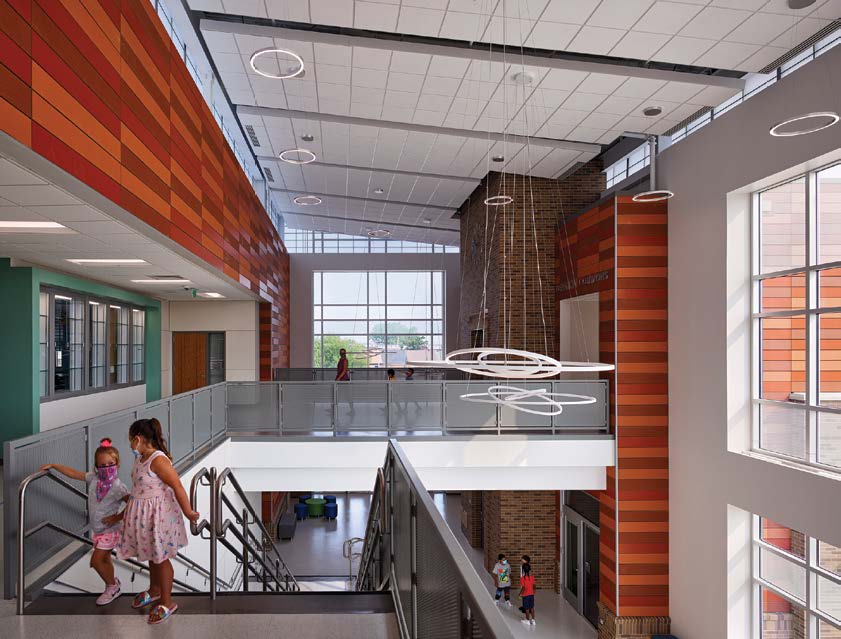 Newer schools are designed with wider corridors and stairs to provide additional room for students to circulate.
Alternative Materials and Methods
The entire construction industry continues to be plagued by supply chain issues that have increased cost for materials, delayed shipments, and affected construction schedules. However, design strategies, including alternative materials and construction approaches, can reduce the impact on project budgets and schedules.
Think beyond brick. Because of ongoing labor shortages, quality masons are scarce. Although stone, brick, and block masonry are staples of K–12 exterior design, consider using alternate facade materials like used metal paneling and terra-cotta siding. These materials can be installed much more quickly, allowing a building to be enclosed and weather tight.
Collaborate with your contractor before selecting materials. Discuss your material selection with your contractor. Contractor insights as to delivery time, availability, and cost can help identify materials that will not be affected by supply chain shortages.
Rethink classroom materials. Very few of today’s classrooms have interior masonry walls; instead, masonry is reserved for the gym, cafeteria, stairwells, and elevators. Classroom walls are now constructed of metal-studded drywall, which is light, inexpensive, and easily adaptable.
Factor in maintenance costs. Reduce long-term maintenance expenses by selecting materials that are efficient and economical. Choosing LED lighting and buying locally are good examples of cost savings and addressing environmental concerns.
Looking Ahead
Educating the next generation of leaders is important. As many of the nation’s K–12 schools continue to age, educators and architects must work collaboratively to create flexible spaces that can adapt to changing pedagogies and technology, ensure the safety of staff and students, and take advantage of new materials and construction delivery methods.