Do creative entrepreneurial thought processes have any place in educational approaches to business management?
Perhaps we can start by defining entrepreneurs as risk takers. Their focus is making a profit, designing product offerings, filling a market niche, and meeting the needs of their customers through innovative ideas. Their communications are focused on sales, and they must be able to move quickly to realign resources to move the processes forward.
Public finance may well seem the polar opposite of these thought processes. In our school business world, we must have safety of revenues, focus on providing services to the community, and communicate in the name of transparency. All decisions have political considerations. With the decisions hinging on board-driven policies, speed is not usually an option.
But why not a public entrepreneur? We are all constantly changing our thoughts on management of people, services, finances—even when it’s uncomfortable and may be unwelcome. Like it or not, we are all living through times we have never seen before, and the way we think and do business is changing. As administrators of public organizations, we are answering to public scrutiny, community pressures, government oversight, and a demand from our communities for transparency.
We must believe innovative thought belongs to the public sector as well. The innovative drivers behind the successful entrepreneur in private business must also drive the public entrepreneur in the school district. The challenge is injecting entrepreneurial spirit and innovation into traditional beliefs and processes of government. We have the ability to stimulate innovation through a problem-solving spirit.
Collaboration is a primary part of the processes of the public entrepreneur—collaboration with community members, local businesses, key stakeholders, finance committees, facilities committees, and any other public committee with input into the organization. Real collaboration allows for sharing ideas and resources across those siloes we work with, be they departments, funding streams, or any other boundary that separates the operation of our organizations.
We must have the ability to work across systems to effect true change. Knowing we can realign resources across our current siloes promotes learning and adaptation, thus laying the foundation for success in meeting and exceeding organizational goals.
Effecting Change in Van Buren
So, what does all this mean? What does this look like in practice in a school district?
Van Buren Local Schools in Van Buren, Ohio, where I served as treasurer and chief financial officer, provides a great example of how to put these principles of public entrepreneurship into practice.
When Superintendent Brian Blum began his tenure in August 2020, he and I made a conscience decision to work and lead as a cohesive team. Several guiding questions were at the forefront of our work as a team going forward:
- What are the best decisions for this district?
- Where are we now?
- Where do we want to go?
- What is the most efficient and effective way to get there?
- What needs to change to reach goals and effect change?
- Who will be involved?
- Where do we start?
Brian had arrived in his new position in the midst of a perfect storm. We were in the center of a community uproar of sorts regarding both financial and overall management.
In 2019, the district financial performance had resulted in a nearly $2 million spending deficit.
The Ohio Department of Education became involved approximately two weeks after I arrived in the district in the fall of 2019. Soon thereafter, the auditor of state arrived to conduct a performance audit based on the district’s projected deficit. Although these occurrences might seem off-putting, ultimately, they worked in our favor by providing data and focus for our work.
For example, the state audit identified seven recommendations that would reduce expenditures or improve the district’s operational management, such as reduce the general fund subsidy of extracurricular activities to the local peer average, eliminate administrative and administrative support positions above the peer average, and eliminate one bus route from the active bus fleet.
It’s best to share here that Brian and I are hardworking people who are willing to share with and commit to the district and our team. We knew the resources needed to be realigned to adopted goals. In the middle of a multiyear spending deficit, every expense needed to be reviewed; every contract needed to be renegotiated or removed.
Plan on a Page
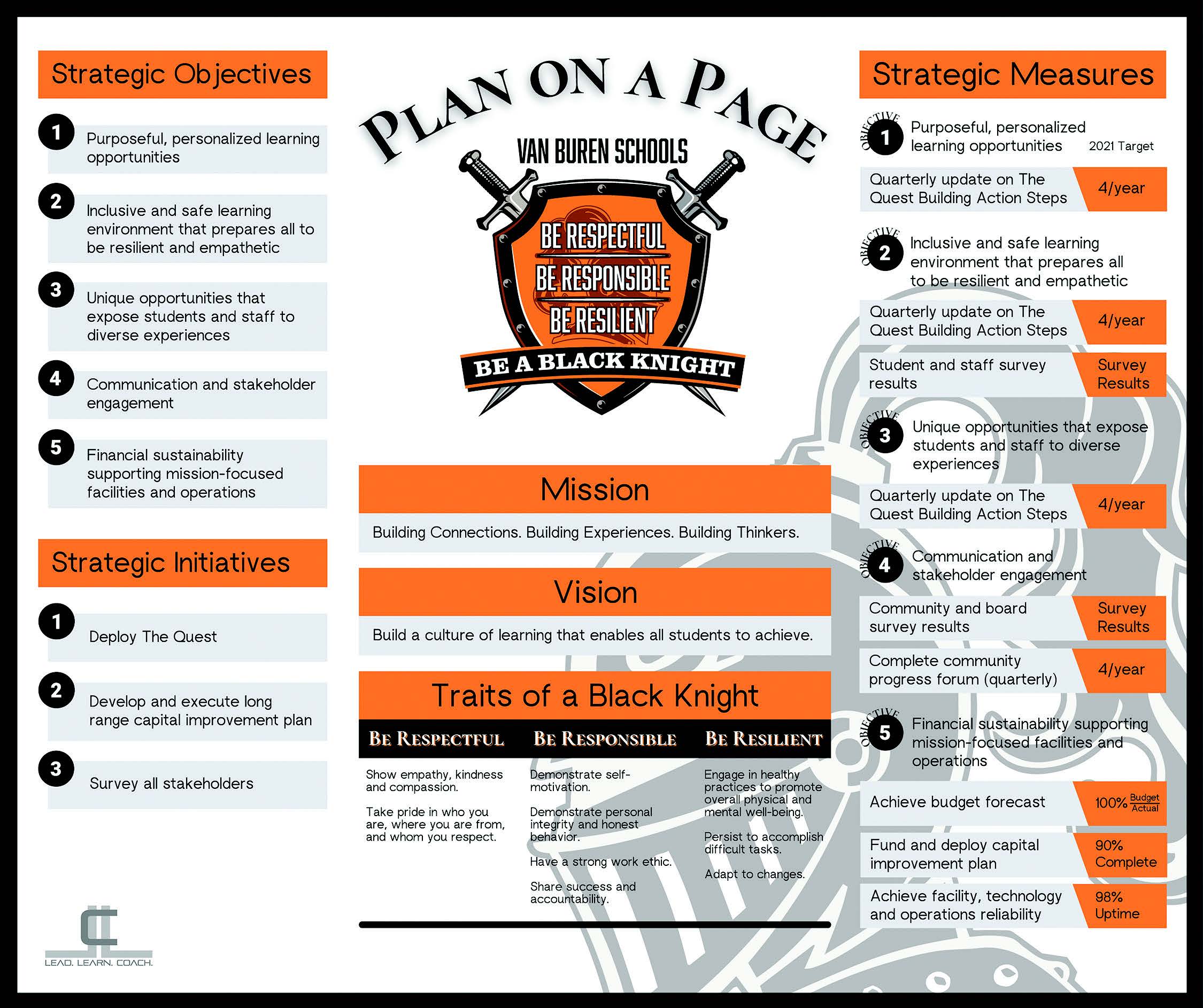
Based on the data and recommendations, Brian and his education team spent their time honing the educational goals for the district (see Figure 1). Immersing the district in the adopted goals, strategies, vision, and mission while aligning the district resources to achieve the district goals was imperative. The battle cry “Be respectful, be responsible, be resilient” echoed across the district. A willingness to move away from “business as usual” contributed to the success of the plan.
Community involvement was a key component of our strategy. When we began developing committees and inviting area stakeholders to participate, the narrative and the understanding of the community changed. The committees worked with specific areas of the district operation. The facilities committee, curriculum committee, and finance and audit committee each included board members, staff members, administrators, and community members. The students and parents in the district also held key roles as we moved through the process.
Once we established our goals and strategies, the administrative team developed a “plan on a page.” This one-page document identified all areas of the plan, outlined the outcomes and criteria for measuring success, and detailed implementation information. Realigning resources as needed during the implementation process is key to the plan’s success.
 Van Buren Local School District
Figure 1. Van Buren Local School District Plan on a Page.
And what were the financial results? For the close of FY 2021, the district experienced the first positive cash flow since FY 2016. From the nearly $2 million deficit in FY 2019, the results for FY 2021 provided a $2.2 million swing in cash position. The inclusion of the community in the ongoing activities and management of the district provided the foundation for the passage of an income tax and the renewal of an existing levy in the middle of a pandemic. That would not have been possible without the changes at the district level.
So do creative entrepreneurial thought processes have any place in educational approaches to business management?
Absolutely! And the success of our case study is simple: innovation. relationships, local resources, problem solving spirit, collaborations, realignment of resources to meet or exceed our goals, building bridges across siloes, answering challenges, narratives for change, adapting and learning, focus on outcomes, public input.
Get out there and be respectful, be responsible, and be resilient.