Begin with Understanding, Not Equipment
Understandably, many school administrators struggle to grasp what true inclusion looks like in a play environment. The challenge often stems from a lack of exposure rather than unwillingness. Teachers — particularly those who work directly with students on the autism spectrum, with sensory processing disorders, or with cognitive disabilities — are the most frequent advocates for spaces that allow their students to engage in play alongside their peers, because they see the value of inclusion for each child.
Inclusion means more than code-compliant ramps or swings. It means understanding the diverse physical, sensory, and cognitive needs of children. For instance, stainless steel components should be manufactured with austenitic (non-magnetic) metal to prevent cochlear implants from being pulled out of the ear. Tread heights and handholds should be carefully designed for individuals with dwarfism. These detailed modifications serve everyone — not just a few — and elevate safety, dignity, and engagement for all users.
Facilitated workshops, collaborative design sessions, and thoughtful stakeholder interviews help lay the foundation for awareness. Once decision-makers truly understand the impact of inclusive spaces, the will to act often follows. Even when awareness is achieved, many school leaders face the next daunting hurdle: finding the resources to bring these inclusive visions to life.
Inclusion means more than code-compliant ramps or swings. It means understanding the diverse physical, sensory, and cognitive needs of children.
Tackling the Budget Barrier
One of the most persistent challenges in building inclusive play spaces is funding. School boards are challenged with weighing limited resources against a long list of priorities, and inclusive playgrounds are often seen as aspirational rather than essential. Meanwhile, grassroots efforts frequently span years, stalling progress while communities raise funds in increments of a few thousand dollars at a time.
When projects are delayed, a generation of children may never benefit. One inclusion-focused park project has been in the works for nearly a decade, progressing incrementally as small donations become available. The children who inspired its creation are now teenagers — arguably too old now to enjoy it fully themselves when it is finally completed.
Strategic partnerships can shift the equation. Special-interest nonprofits like Unlimited Play and Harper’s Playground, municipal alliances, and joint-use agreements are tools that can help schools locate, secure, and share both costs and benefits. A professionally developed plan — rather than a conceptual napkin sketch — is fundamental to unlocking funding through grants and inspiring private donors to give.
Other funding mechanisms, such as bond measures, can also play a pivotal role in supporting capital improvements such as inclusive playgrounds. The design is only part of the story; fundraising strategy is just as vital. However, inclusive design isn’t only about dollars and materials—it also depends on who is invited into the conversation and how their voices are heard.
Moving Beyond Performative Engagement
Authentic inclusion begins with deep, intentional engagement — not surface-level surveys or one-off community meetings. In many school districts, outreach efforts tend to amplify only the most vocal stakeholders. As a result, the perspectives of families with disabilities often go unheard.
Layered engagement approaches — small focus groups, targeted interviews, and inclusive public workshops — offer more meaningful insight. When families are invited into the process from the start, the resulting design is more equitable, more beloved, and more likely to succeed.
A guiding principle emerges: “You can’t design for me without me.” Inclusion is not a one-size-fits-all checklist — it’s a process that centers on lived experience. Engaging those who will use and be impacted by the space leads to designs that reflect a full spectrum of needs. Authentic engagement lays the groundwork, but sustained momentum often hinges on how inclusion is positioned within broader district priorities.
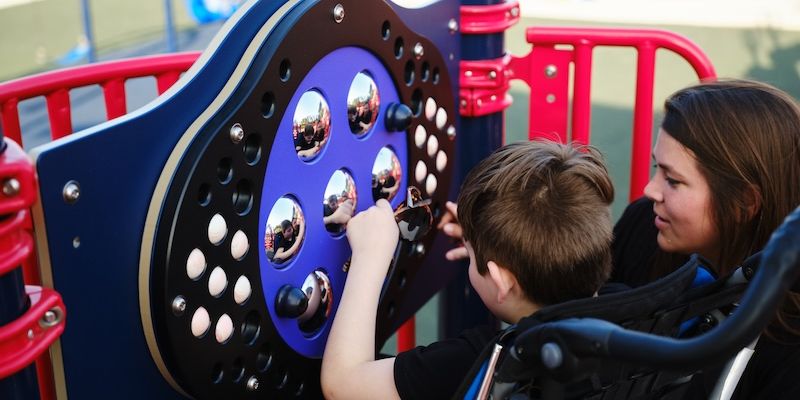
Photos Courtesy of Westwood Professional Services
Designing a space that supports diversity and balances budget constraints requires thoughtful planning.
Inclusion as a Strategic Investment
School boards often wrestle with balancing the needs of many against those of the few. But the inherent beauty of inclusive playgrounds is that they are not for children with disabilities — they are for everyone. Features that improve accessibility often make spaces better, safer, and more engaging.
Framing inclusion as a long-term investment helps shift school board perspectives. Inclusive playgrounds tend to align with broader district goals — health, equity, social-emotional learning, and civic pride. They demonstrate a commitment to all children, not just those who fit the typical mold.
Often, board members become more receptive when they see how inclusive play supports community cohesion and lifelong impact. It’s not a fringe benefit — it’s foundational to a thriving school culture.
Still, acknowledging the need for change can be difficult. For some school leaders, suggesting that playgrounds should be designed differently may be interpreted as an admission of past shortcomings — an implication that something was previously done wrong. That perception, however unspoken, can become an obstacle for political support and eventual implementation. When inclusion is embraced as a long-term value, it becomes possible to focus more intentionally on the quality and creativity of the play environment itself.
Designing for the Experience, Not Just the Structure
Prioritizing the experience of play — not merely the equipment — is key to creating inclusive environments. Play equipment is not the whole picture. Great play spaces are built around creativity, exploration, social connection, and sensory richness.
Trends in playground design often favor high-cost themes — spaceships, castles, racecars — but these can come at the expense of actual play value. Alternatively, natural elements like logs, boulders, and plants can bring beauty, accessibility, and open-ended fun. These features offer tactile and visual stimulation, encourage imaginative use, and are adaptable to a range of physical abilities.
Loose play components — blocks, scoops, buckets, manipulatives — are gaining ground, especially in early education settings. These can be stored securely by teachers, reducing theft while supporting classroom integration. Unlike permanent structures, loose play items offer dynamic, diverse, and dependable engagement.
Importantly, good playgrounds also allow for safe risk-taking. Confusion between danger and risk often leads school administrators to remove swings or limit climbing elements. Yet risk is a healthy, necessary part of childhood development.
With proper design — such as shock-absorbing (attenuating) surfacing and well-proportioned equipment — children can make age-appropriate choices, building confidence and resilience. With thoughtful planning and design, play spaces can foster joy, development, learning, and connection for all students. But how can school leaders begin to elevate their own projects?
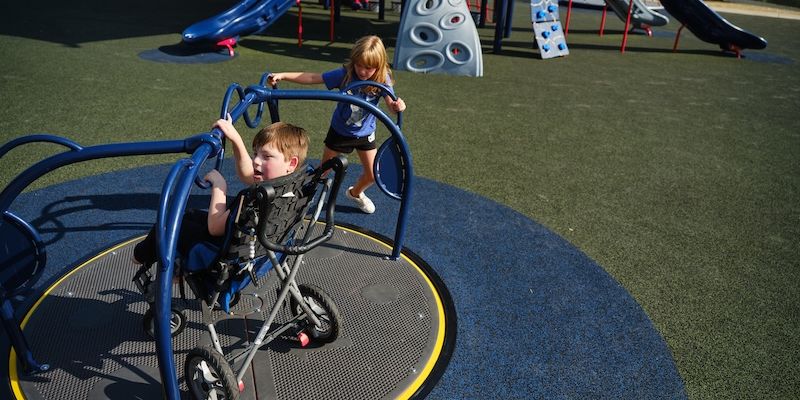 Photos Courtesy of Westwood Professional Services
Playgrounds designed with inclusivity in mind transcend physical boundaries and redefine recreation as a shared experience for all.
Tips for Leaders Ready to Go Further
For districts eager to raise the bar on their next playground project, several guiding strategies emerge:
1. Center the Play Experience. Design with joy, creativity, and engagement in mind—not just code compliance. Consider how natural features and flexible elements enhance play for all learners.
2. Build a Diverse Design Team. Don’t default to equipment vendors. Instead, collaborate with professionals who bring diverse perspectives: landscape architects, occupational therapists, disability advocates, and researchers. Their collective expertise ensures a more inclusive and innovative result.
3. Involve the Community. True inclusion demands collaboration. Engage parents, teachers, and students — especially those with disabilities — from day one. Their voices lead to spaces that reflect real needs and deliver lasting value.
4. Integrate Play with Learning. Outdoor environments can be teaching tools. Inclusive design that supports curriculum goals fosters empathy, advocacy, and connection in both students and teachers.
Following these guiding strategies can help schools make meaningful strides toward equity—but beyond the process lies a much deeper message.
Every Child, Every Right to Play
Inclusive playgrounds aren’t about special treatment — they’re about equal and just opportunity. They tell a story about what a school/community values, and who it values. They foster dignity, agency, and joy for every child.
Each ramp built, each handhold adjusted, and each community voice honored brings us closer to a more equitable future. With the right team, tools, and intention, inclusive design is not only achievable — it is transformative.