How School Business Leaders Value Federal Advocacy
When respondents were asked to rate the importance of federal advocacy as an ASBO International member benefit, 85% said it was very important, 11.5% said it was somewhat important, and only 4.5% said it was not that important.
An overwhelming majority of members believe that federal advocacy is a significant benefit of joining ASBO International. They value ASBO’s role in unifying, elevating, and amplifying the school business professional’s voice in Washington, D.C. Members noted that many school districts and state ASBO affiliates lack the bandwidth to engage in federal advocacy and rely on ASBO International to help bridge that gap.
School business professionals recognize federal advocacy as vital to securing and sustaining strong funding for Title programs under the Every Student Succeeds Act (ESSA), special education under the Individuals with Disabilities Education Act (IDEA), and various school nutrition programs. They also recognize the role the federal government plays in providing supplemental resources for specific student populations that require additional support, which districts cannot address through local funding alone (e.g., students in rural, remote, and federally impacted areas; low-income students; students with disabilities, etc.).
ASBO members acknowledge how federal policy shapes state and local policy and decision-making, and they believe ASBO’s advocacy efforts help address diverse district needs amid political and financial uncertainty. School business professionals seek strong advocacy support as public education faces increasing scrutiny, budgetary pressures, and a shifting federal role in the current climate. They see the tangible outcomes of ASBO’s advocacy efforts over the years, from securing critical ESSER funds during the COVID-19 pandemic to persuading lawmakers to quickly release Title funding allocations that were delayed last summer.
Members understand how advocacy can help educate elected officials and other public stakeholders about school finance topics, which are often misunderstood. They appreciate ASBO International for providing clear, timely federal information and helping school district leaders build relationships with their federal representatives. Even respondents who said federal advocacy was not a particularly important benefit acknowledged that it has become increasingly relevant in recent years.
What Are SBO Advocacy Priorities for 2026?
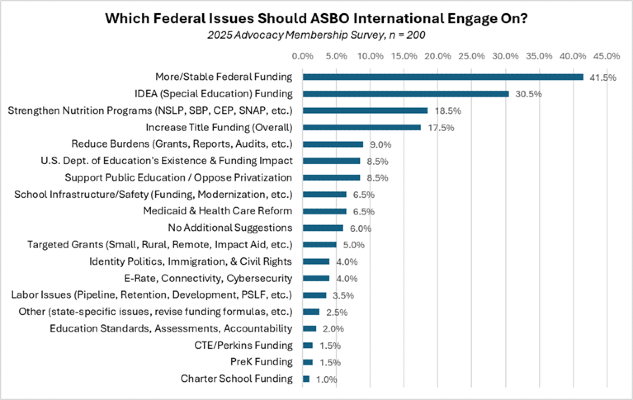
Members were asked to share federal policy issues that they’d like ASBO International to focus on in 2026. Nearly all members' suggestions already align with ASBO International’s current advocacy agenda; however, some new issues that were raised in the survey will be reviewed by ASBO International’s Federal Advocacy Advisory Committee (FAAC) as they work with ASBO’s Board of Directors to update the association’s federal priorities for 2026-27.
Credit: ASBO International
Respondents shared issues that they’d like ASBO International to advocate on in 2026, from ASBO International’s 2025 Advocacy Member Survey.
Members’ top priorities were to secure more federal funding and more stable funding overall, to focus specifically on funding for IDEA, and to advocate for funding and support for various child nutrition programs. Two new issues emerged from the survey: addressing the changing role and scope of the U.S. Department of Education and how that will impact federal funding, and advocating specifically to preserve and strengthen the Supplemental Nutrition Assistance Program (SNAP). (Historically, ASBO International has only advocated for SNAP-related policies as they pertain to school meal programs, since SNAP participation affects direct certification for free/reduced school meals and Community Eligibility (CEP). However, as more members are acknowledging the value of SNAP as a standalone program to address food insecurity for children at home, ensuring they arrive at school well-fed and ready to learn, they are asking ASBO International to broaden its policy stance in its advocacy agenda moving forward.)
Other priorities mentioned by members include advocating to reduce administrative burdens, supporting public education, and opposing privatization, as well as increasing funding for school infrastructure and Medicaid in schools. Less common recommendations suggested advocating for specific targeted programs (e.g., Impact Aid, REAP, and other programs to support small/rural schools); identity politics and civil rights issues (e.g., Title IX/LGBTQ+, immigration, and race/equity issues); more E-Rate, cybersecurity, and other technology funding; addressing labor shortages and strengthening the K-12 labor pipeline; accountability and assessments topics; and more funding for CTE, PreK, and charter school programs. All member feedback will inform the work of ASBO’s FAAC (formerly known as the Legislative Advisory Committee [LAC]) as they recommend updates for ASBO’s 2026-27 U.S. Policy Priorities for the Board this Spring.
Helpful Advocacy Resources for ASBO Members
Regarding the Advocacy Conference, only 10% said they had attended the event before; however, many members said they were interested in attending but haven’t had the chance due to time and bandwidth constraints (34.5%) or budgetary constraints (25.5%). School business professionals who are interested in attending the 2026 AASA/ASBO International Legislative Advocacy Conference can do that now, as event registration just opened last week!
It is YOUR stories that will impact policy—it is your voice and participation that lead to successful efforts.
Member feedback is critical to helping ASBO International enhance its federal advocacy program and provide even better information, tools, and resources to support school business professionals and ASBO affiliate organizations. When members share their federal advocacy priorities, key issues impacting their district, and how they prefer to access information and advocacy opportunities, ASBO International can use that data to fine-tune its advocacy agenda and communications to be more responsive to member needs.
“Advocacy matters because lawmakers need to understand the realities we live every day. When School Business Officials engage with ASBO’s Federal Advocacy Advisory Committee (FAAC), we convert member insight into meaningful federal action that protects students and strengthens our public schools,” says FAAC Chair, Christopher Smith, who serves as CFO for Katy Independent School District in Katy, Texas.
FAAC Vice Chair, Erik Roush, PhD, Executive Director of Financial Affairs for Columbus City School District in Columbus, Ohio, adds, “ASBO International, through its staff and its volunteer members of the Federal Advocacy Advisory Committee, works diligently to share the impacts of federal action on public schools and advocate for policies and legislation that work to provide an improved environment for school business operations. The voices of members are a critical piece of our work—the recent survey is a good example of how we are engaging our members on what matters most to them and how we can best educate our members of federal activities.
Thank you to all ASBO International members who completed the advocacy survey. We look forward to sharing the association’s 2026-27 U.S. Policy Priorities with members this Spring. Know that your voice matters and your advocacy is key to making a positive difference in education!