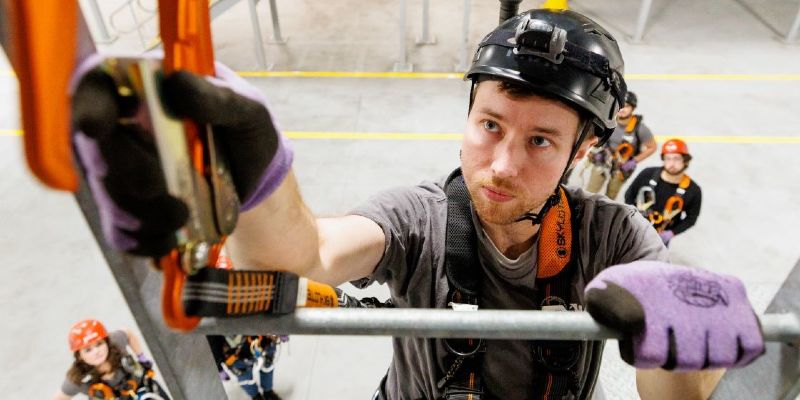
 Millwright trainees at National Offshore Wind Institute, New Bedford, Massachusetts. Photo courtesy of Bristol Community College, 2026. Photograph by James Jones.
With the encouragement of parents, young folks begin to think about careers at an early age. School business officials, along with other educators and career guidance counselors, can be active participants in what I recognize as Sustainability Career Ladders (see Figure 1). SBOs assist by providing students with qualified professional and support personnel, curriculum, supplies and equipment, and safe and healthy school facilities for whatever career path they choose.
As educators, we must provide encouragement and training to our students who will become tomorrow’s climate-critical workforce.
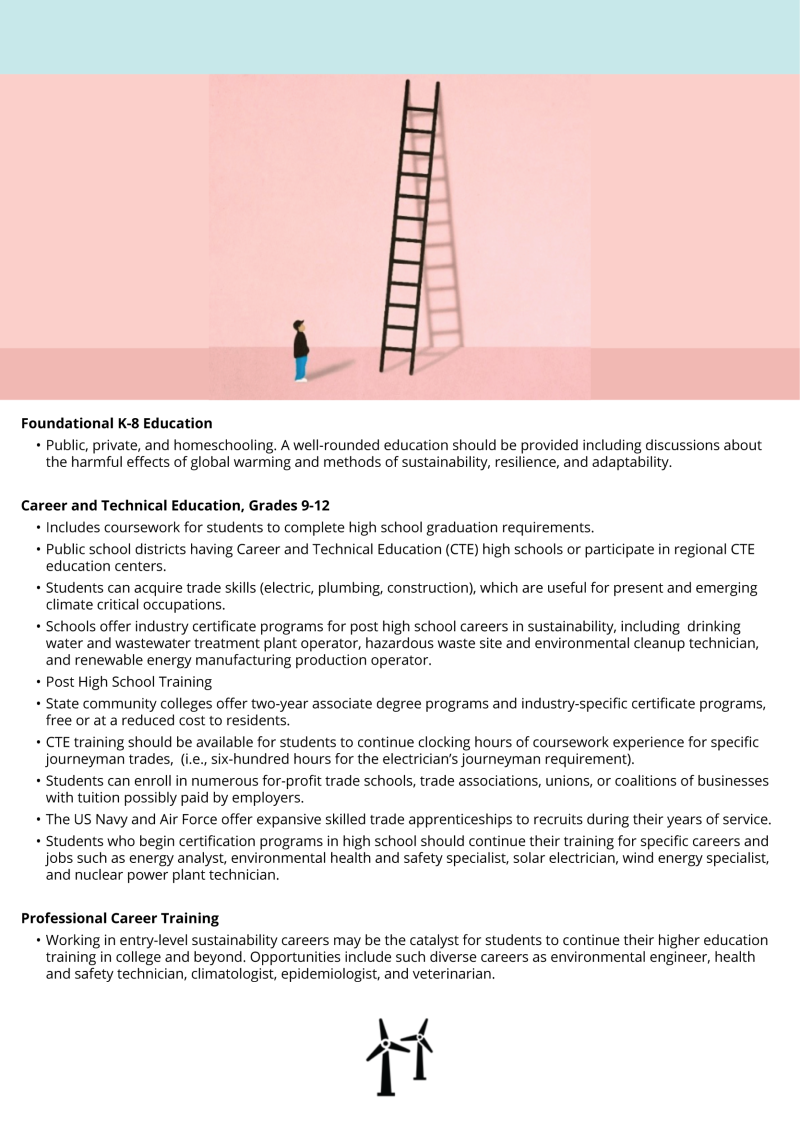 Sustainability Career Ladder
Careers in Direct Energy Production
Today’s sustainability workforce is working in readily identifiable camps: direct energy production, indirect or supply chain jobs, construction, technology, and transportation. As electricity replaces oil as the primary source of energy, nearly all jobs will require vocation-specific electric skill training. Decarbonization is a primary objective in all camps. These are recent developments in direct energy production careers:
Construction apprentices on utility-grade wind turbine farms are in familiar territory. As recently as a generation ago, their fathers may have worked in the same fields managing the oil rigs. They have well-paying jobs and live or work near their hometowns, primarily in rural areas across over 40 states on land and offshore. Once installed, the turbines require technicians for electrical and mechanical support.
According to the U.S. Bureau of Labor Statistics 2025 “Occupational Outlook Handbook,” employment of solar photovoltaic installers is projected to grow by 42% from 2024 to 2034, much faster than the average for all occupations. PV installers may be self-employed or work for companies that provide training on specific manufacturers’ products. Many states require a license for PV installers, especially if local projects are to qualify for solar-related subsidies.
High school graduates have numerous opportunities working in the geothermal residential or utility-scale industries. In residential construction, laborers, pipefitters, and plumbers install underground piping to pump warm water in the winter, and cold water in the summer into the buildings’ HVAC units.
New school construction effectively utilizes geothermal systems. Located primarily in Western states, utility-scale geothermal plants generate electricity from underground steam for the power grid. Numerous entry-level positions are available, with certifications signifying workers’ supplemental training as energy system installers, plant mechanics, and plant technicians.
Careers in Sustainable Construction
At Greater Lawrence Technical School in Andover, Massachusetts, a special program is tailored for high school students interested in a technical career pathway upon graduation. In the morning, students attend their home high schools for academic classes from 10 a.m. to 2 p.m. In the afternoon, they attend the After Dark Program from 3 p.m. to 5:30 p.m., which allows the students to receive career training.
When they successfully complete the program, students receive their high school diploma from their home high schools and a technical certification of completion from GLTS that qualifies them for entry-level jobs as apprentice HVAC laborers and installers.
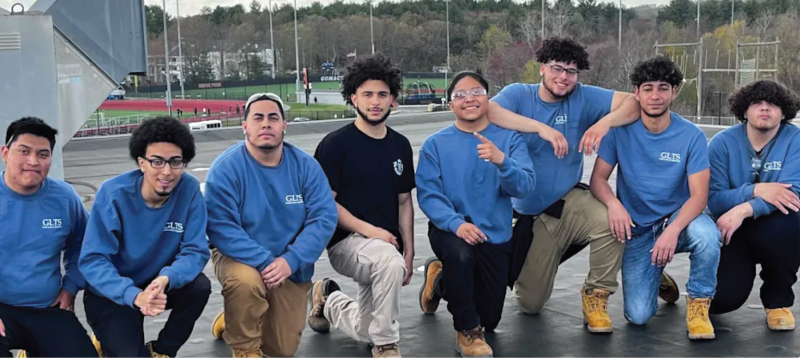 Apprentice HVAC students at Greater Lawrence Technical School, Andover, Massachusetts. Photo courtesy of Greater Lawrence Technical School, 2026.
Community colleges, including Kennebec Valley Community College in Fairfield, Maine, are offering two-year Sustainable Construction degree programs. They are structured to provide students with the technical knowledge and hands-on skills needed to pursue employment across many areas of the construction industry, including carpentry, project management, design, building inspection, and renewable energy installation.
The programs challenge students to think about how buildings can be constructed at a higher but achievable level of quality and energy efficiency. Key sustainability concepts often include sourcing of local materials, reduction of energy loads, optimization of systems, and the generation of onsite renewable energy.
Nearly Limitless Career Opportunities
Who is making the blades that are attached to the wind turbines? What about the industrial-sized batteries used to store electricity at the solar farms? The answer is that new energy production sources have spawned thousands of indirect or supply chain jobs in these industries.
Electric vehicles will eventually dominate our motorways due to their superior technology and affordability. According to Caleb Miller, writing for the January 2026 issue of Car and Driver Magazine, “Electric cars are the future and each year we’ve seen automakers add more EVs to their lineups, from well-established manufacturers to new names.” To service the new EVs, community colleges are providing associate degrees and certificates in EV automotive technology.
As educators, we must provide encouragement and training to our students who will become tomorrow’s climate-critical workforce.