Why the Language Gap Matters
Misunderstandings during facility work rarely stem from bad intentions. More often, they arise when education professionals and design or building experts interpret the same words differently. Terms like budget, estimate, contingency, or change order carry specific technical meanings, and misalignment around those meanings can lead to frustration, mistrust, and unexpected costs.
When district leaders understand the language of design and construction, they are better equipped to ask the right questions, evaluate professional recommendations, and protect their district’s financial and operational interests.
Legally, a project is complete only after substantial completion, the resolution of punch list items, final inspections, and the submission of required close-out documentation.
Early Preparation: Understanding the Financial Landscape
Capital initiatives begin long before renderings are created and construction documents are drawn. Early preparation starts with understanding how the effort will be funded. In many states, districts rely on combinations of operational funds, debt-levied funds, capital project funds, and voter-approved referendums.
Each funding source carries different requirements and timelines. Establishing a capital projects fund, for example, requires board approval, a defined list of eligible projects, and disciplined long‑term planning—including allocating dollars years in advance of use. Engaging financial advisors early allows districts to assess affordability, anticipate the impact of tax rates, and plan bond issuances strategically.
Financial vocabulary also matters. A sound budget should include a financial plan with assumptions and safeguards built in. For example, an estimate is a projection that becomes more accurate as design decisions are refined, while a bid is a contractor’s firm price based on finalized documents. Confusing these terms can create unrealistic expectations and unnecessary tension.
From Data to Direction: The Importance of Studies
Before facility solutions are proposed, districts must gather and understand data. Several studies help frame responsible decision‑making, each serving a distinct purpose.
A facility study examines the physical condition of existing buildings and infrastructure. From roofs and boilers to pavement, kitchens, and classrooms, it assesses current conditions and forecasts remaining life expectancy while offering professional recommendations for future action.
Often completed alongside the facility study, an educational adequacy analysis (EAA) evaluates how well existing spaces support instruction. It considers student capacity, instructional strategies, safety, security, technology, and how spaces are actually used, highlighting gaps or inefficiencies.
Once condition and adequacy data are collected, a needs prioritization translates information into actionable sequencing. Identified needs are grouped by urgency so districts can plan responsibly rather than reactively.
A feasibility study brings all this information together to explore potential solutions. It considers financial capacity, legal requirements, operational impacts, timelines, and community context to determine what options are realistic and achievable.
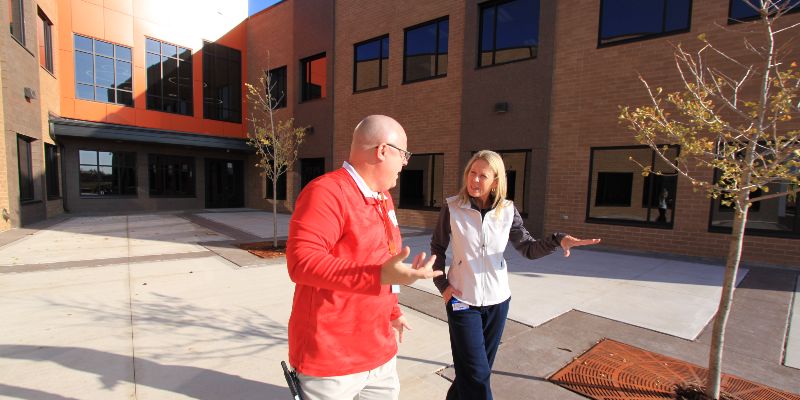
Capital investments are more likely to be successful and result in safe, functional, high-performance learning environments when educators and industry professionals are on the same page where terminology is concerned. Photo credit: Hoffman Planning, Design & Construction, Inc.
From Abstract to Concrete: The Design Phases Explained
Architects typically guide districts through three primary design phases, each with increasing levels of detail and commitment.
1. Schematic design is where big ideas take shape. Educational goals and facility needs are translated into preliminary layouts and concepts. Early cost estimates are developed, and leaders focus on adjacencies, circulation, and overall scale.
2. Design development refines the selected concept. Floor plans become more detailed, systems are defined, and materials take shape. Cost estimates are updated to confirm alignment with the approved budget.
3. The construction documents phase produces the detailed drawings and specifications contractors rely on to price and build the work. Once these documents are complete and bidding begins, flexibility narrows significantly. This is the point where “I changed my mind” becomes “I need a change order.”
Change Orders, Contingency, and Scope of Work
Few construction terms generate more anxiety than change orders. A change order is a formal modification to a signed contract that adjusts the scope of work, schedule, and/or cost. Because contractor pricing is based on the bid documents, any modification must be formally documented and priced.
This is why project budgets include a contingency. Contingency funds exist to manage uncertainty, not to absorb avoidable indecision. Frequent change orders can quickly erode these reserves, underscoring the importance of clarity early in the process.
Understanding Roles and Responsibilities
Another common area of confusion involves who does what. Districts typically choose between a construction manager (CM) or a general contractor (GC).
A construction manager is usually hired early in the design phase (or sometimes even during planning) to function as the owner’s advisor, focusing on planning, budgeting, scheduling, and coordinating the project on the owner’s behalf.
A general contractor, on the other hand, is responsible for executing the physical construction work itself, managing subcontractors, materials, and day‑to‑day site operations once the project is ready to be built. While both deliver facility work, their structures differ.
Construction managers often organize projects into divisions of work, which are competitively bid and coordinated. Districts should also understand the distinction between CM-at-risk and CM-agency, as the responsibilities for contracts, insurance, and payments vary significantly.
Are We Done Yet? Defining Project Completion
Facility work does not end the day students walk into the building. Near the end of construction, teams develop a punch list, identifying minor items that must be corrected before final acceptance. Many districts also benefit from an 11‑month walkthrough, identifying warranty issues before coverage expires.
Legally, a project is complete only after substantial completion, the resolution of punch list items, final inspections, and the submission of required close-out documentation.
Understanding design and construction terminology empowers district leaders to collaborate confidently, make informed decisions, and communicate transparently with their communities. When educators and industry professionals speak the same language, capital investments are more likely to deliver safe, functional, long‑lasting learning environments for students and staff.