Return on Investment
During the past four years, Fairfax County Public Schools (FCPS) in Virginia has worked to maximize the use of existing dollars by implementing return-on-investment (ROI) approaches. Using ROI allows FCPS to capture the benefits of its investments more systematically, especially when those investments are large.
By quantifying the effectiveness of its budget decisions, ROI sets the school district up to reallocate dollars toward the most pressing and significant needs. ROI also supports the school district’s commitment to being a responsible steward of public funds by providing accountability and transparency for stakeholders.
As it is traditionally used in the private sector—to earn profit—ROI does not align with a typical school division’s interests in accounting for the dollars spent on the education process. In education, expenditures are made in pursuit of variable outcomes, including nonmonetary benefits (primarily student achievement), monetary benefits, or a combination of nonmonetary and monetary results.
By quantifying the effectiveness of its budget decisions, ROI sets the school district up to reallocate dollars toward the most pressing and significant needs.
FCPS’s ROI Approach
Important distinctions exist between public- and private-sector expectations for outcomes from dollars they spend. Clarifying those distinctions can help facilitate discussions between publicly funded organizations, such as school divisions, and their community funding sources, which are increasingly more likely to ask for the documented benefits, or return, of particular expenditures.
Further, a single “umbrella” approach will likely be incapable of evaluating all of a school division’s expenditures in relation to the varied benefits. Therefore, after reviewing available literature on ROI, FCPS developed its own set of ROI approaches that are tailored to the context of a K–12 school district.
FCPS’s ROI analyses rely on a continuum of approaches to evaluate the link between expenditures and benefits.
Cost per participant describes expenditures in relation to the number of participants in a program or project, or the number of recipients of services. This approach answers the simple question, “How much was spent for a single participant or beneficiary of the program, service, project, or initiative?”
Cost description is a process of identifying observed benefits or outcomes that are associated with a specific program, service, project, or initiative that has been funded, such as improvements to student achievement, operational efficiency, or teacher retention. This approach answers the question, “Were the expected benefits from the expenditure observed?”
Monetary ROI evaluates whether a monetary investment results in a monetary gain larger than the initial investment amount (e.g., cost savings or cost avoidance). This approach answers one of two questions: “What amount of savings was realized because of the expenditure?” or “What amount of future expenses may be avoided because of the expenditure?”
Impact ROI is used to show nonmonetary benefits—such as student achievement, operational efficiency, teacher retention—associated with the funding of a program, service, project, or initiative compared with the benefits and associated funding for a different program, service, project, or initiative (either within or outside FCPS). This approach answers the question, “How do instructional or operational benefits that are observed after funds are spent compare with similar expenditures within the school division, outside the division, or to a predetermined baseline?”
Social ROI evaluates a combination of monetary, impact, and community outcomes to assess the full effect of funds spent. Monetary and impact outcomes are defined in the same way as they are in the monetary and impact ROI approaches. Community outcomes include those benefits to others outside the school division, such as increasing civic engagement, decreasing incarceration rates, or reducing reliance on public assistance programs. This approach answers the question, “What is the total financial return when all monetary, impact, and community benefits from funds spent are assigned a financial value?”
Using ROI Approaches
Choosing an approach to evaluate the link between a specific expenditure and its associated benefits in a school division will be based on the question being asked. In general, these questions converge around the types of benefits expected from a given expenditure and the expected recipient of those benefits.
The choice of approach also depends on complexity and time. The less complex approaches of cost per participant and cost description are more descriptive than evaluative, merely describing outcomes observed after funds are spent. The more complex approaches of monetary, impact, and social ROI become increasingly evaluative and, in some cases, can definitively link specific expenditures to their related benefits.
Evaluative approaches also allow for judgments on the efficacy, or success, of an expenditure and so are especially important in supporting repurposing of funds. However, these more complex approaches require the availability of certain data and the ability to dedicate expertise and time to the analysis.
The more complex approaches of monetary, impact, and social ROI become increasingly evaluated and, in some cases, can definitively link specific expenditures to their related benefits.
For example, social ROI requires the most time and extensive data and expertise. It requires a deep understanding of both the short-term benefits (which may or may not be observable at the point of conducting the analysis) and the long-term benefits that are expected to be associated with the particular expenditure. Such knowledge typically requires either expertise in the area or an extensive review of the literature to identify the benefits.
Further, each benefit must be transformed into a monetary unit, which requires experts and key stakeholders to reach a consensus on the worth of nonmonetary benefits. As such, this complex process may be prone to error but, if done effectively, can provide the most comprehensive snapshot of the impact of specific expenditures on monetary savings, impact benefits, and the community. In fact, FCPS has yet to conduct a social ROI.
FCPS’s initial forays into using ROI approaches were undertaken by its Office of Research and Strategic Improvement as part of comprehensive studies of the school division’s preschool program, services for English-language learners, and professional development offerings.
The monetary ROI of its preschool program indicated that although program costs are large, the school division can potentially recoup up to 94% of its investment in the program by decreasing the need for English-language learner services among former preschool participants. The impact ROI on FCPS’s services for English-language learners found that while costing more, a revised high school program piloted at two schools had greater ROI in credits earned toward graduation, which supported the expansion of the program into all high schools in the division.
However, the monetary ROI conducted as part of the study of professional development yielded less positive results; although it was hoped that designating professional development days on the school calendar would meaningfully reduce substitute costs, a monetary ROI found that only 3% of the investment was recouped through lower substitute costs.
Making Strategic Decisions about Funding
In expanding its use of ROI beyond the in-depth studies, FCPS has also embedded ROI analyses within a broader framework of continuous improvement that we refer to as the Strategic Decision-Making Cycle for Resource Allocation (SDMC).
As was true in developing its approaches to ROI, FCPS developed the SDMC framework after a review of recommended practices for organizational decision making and strategic budgeting. The SDMC framework—which reflects a Plan-Do-Study-Act cycle of continuous improvement—focuses on a series of systematic steps for deciding how and where to allocate funds and other resources to best support FCPS’s strategic aims.
The SDMC allows FCPS to connect its strategic work, decisions about the effectiveness of its actions, and resource allocation. The cycle requires the following steps:
- Identify and align the most critical resources to current strategic aims (Plan)
- Allocate and monitor the use of funds toward specific aims (Do)
- Monitor and communicate the impacts of resources (Study)
- Adjust resource allocations for subsequent years based on impacts (Act)
The SDMC is FCPS’s focal point for aligning money and resources with the work it has prioritized through its strategic plan. The overall aim of the SDMC is to guide FCPS’s alignment of resources with the school district’s priorities and judge whether resources have been used effectively. ROI plays a central role in these decisions by providing information for understanding the relation between expenditures and outcomes. This knowledge should improve FCPS’s ability to evaluate the effectiveness of dollars spent and, in turn, guide informed decisions about resource allocation and reallocation in relation to priorities.
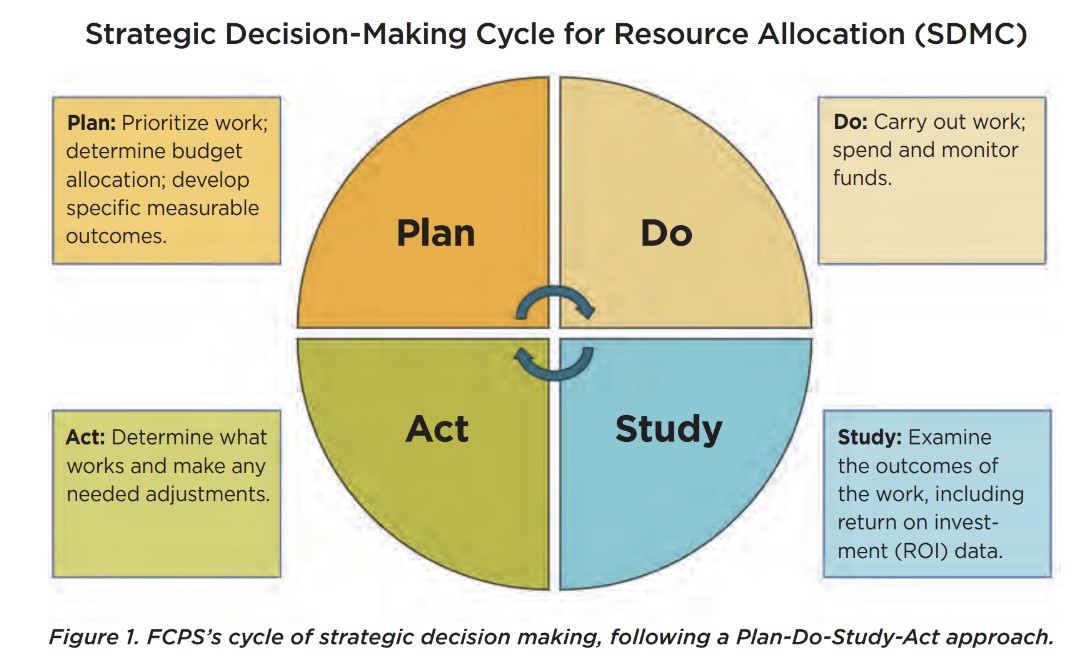
Two years ago, FCPS revised its annual strategic plan reports to reflect the SDMC. The reports now provide information about current performance on metrics in relation to intended performance levels, descriptions of actions undertaken in support of improved performance, ROI data on actions, and conclusions about which actions should be taken next to meet strategic goals.
The more complex approaches of monetary, impact, and social ROI become increasingly evaluative and, in some cases, can definitively link specific expenditures to their related benefits.
For example, the most recent annual reporting about teacher retention indicated that FCPS invested $41,000 in the school district’s teacher induction program per 1% improvement in retention among new teachers. This finding led to a recommendation that the program be expanded by making it mandatory for new teachers rather than optional.
Moving forward, FCPS is interested in conducting impact ROI on its varying recruitment efforts to gauge which are most cost-effective in yielding the highest number of qualified teacher applicants or monetary ROI on the recoupment of staff attendance, employee retention, or employee performance costs by offering its Employee Assistance Program.
Moving Forward with the SDMC and ROI
The biggest lesson learned so far is that it takes time to create a culture where ROI thinking and strategic decision making are commonplace. Thus, expectations for both internal and external stakeholders need to be calibrated to reflect this reality.
FCPS’s size—over 28,000 staff positions and a $3.2 billion budget—may make this task more complex than doing so in a smaller school district; however, any school district that undertakes embedding ROI or strategic decision making will need to be patient (and convince stakeholders to be, as well) as it works to adapt old processes and structures and adopt new ones to accommodate the many ways in which ROI and the SDMC intersect with other functions.
With the development of the ROI approaches and the SDMC framework completed almost two years ago, FCPS continues to evolve its structures and processes to further embed them into its functioning. Over this period, FCPS has updated its budget development process to require department assistant superintendents to submit supporting information that links individual budget requests to their intended strategic purpose. FCPS’s senior leadership then prioritized the requests with their strategic purpose in mind.
Ultimately, FCPS reflected these decisions by providing budget information aligned to specific strategic aims. For example, in the most recently proposed budget, FCPS was able to report that 55% of its proposed budget changes for the upcoming year were being requested in support of its strategic outcomes related to human resources (market competitive compensation, exceptional employees). Although this process is in its early stages, further development is expected to enhance FCPS’s ability to allocate resources.
FCPS has also revamped its school improvement planning process to embed SDMC characteristics into school improvement efforts to better support schools’ work toward strategic aims. Lastly, the division has launched a cross-functional work-planning structure that requires the identification of resources being used for strategic efforts and, consequently, provides improved information for ROI analyses.
Moving forward, FCPS will continue to expand structures that allow the school district to make increasingly better budgeting and allocation decisions associated with its strategic aims. Expansion should include identification of a small number of high-level efforts that FCPS will undertake to achieve with specific linkages to needed funds and staff. These focused efforts should support higher levels of ROI information (monetary and impact ROI) to better inform further budgeting and allocation decisions. To truly repurpose funds will require hard decisions informed by ROI analyses.