Although there are several alternatives to traditional fundraising endeavors, one strategy in particular has been gaining traction in the education arena: crowdfunding.
Crowdfunding is the practice of financing a project or venture by raising small amounts of money from a large number of people. Recent statistics indicate that more than $17.2 billion is generated yearly through crowdfunding in North America, and the popularity of this financing tool continues to grow.
How can school district leaders leverage the benefit of crowdfunding for their schools while maintaining internal controls and student protection?
Considering Crowdfunding
Crowdfunding sites like GoFundMe, Kickstarter, and DonorsChoose—which is dedicated to educators— address both problems: Districts can appeal to a large audience across all income levels with much less effort.
School district leaders may be in the best position to leverage the additional funding that crowdfunding sites offer. They are also responsible for protecting the district and its stakeholders by clearly articulating goals and acceptable projects, and by maintaining internal controls and appropriate protocols to protect staff members and students.
When considering a crowdfunding strategy, it is important to first review the school board’s fundraising policy. Consider whether the resources will be used to finance a one-time project or a project or program that will be ongoing. Expectations must be clear so that the district isn’t left with recurring expenses after the resources are depleted. If the resources are to be used to acquire a capital asset, district leaders should also consider ongoing “tails,” such as property insurance, maintenance costs, and asset replacement cycle.
After a project has been studied and accepted, school district leaders can select the appropriate crowdfunding platform.
Selecting the Platform
In selecting a crowdfunding platform, district leaders must perform due diligence. We all recognize the responsibility of taking on financial risk and protecting our staff and students, but an equally important consideration is reputational risk. The crowdfunding platform must have an impeccable reputation and, like the district, it must have appropriate internal controls.
Selection of a reputable platform can reflect favorably on the district and increase trust within the greater community. Consider the following factors when evaluating crowdfunding websites:
- Financial accountability
- Ownership of materials and supplies
- Safety and privacy
Ensure that the crowdfunding websites meet these criteria:
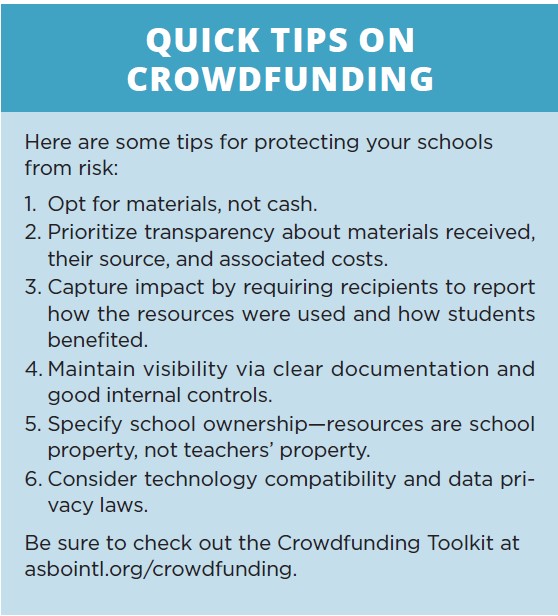
- Purchase and send resources directly to verified schools instead of depositing cash into teachers’ personal bank accounts. If your staff members receive cash, it can put them and the district in a risky situation.
- Publicly display details about every item funded and provide a clear explanation of overhead costs.
- Require teachers to report how the resources were used in the classroom and how students benefited.
- Designate that the school, rather than the teacher, ultimately owns the funded resources.
- Notify principals when items are shipped and provide line-by-line reporting of every item to the district upon request.
- Have mechanisms in place to protect students’ privacy, as well as a privacy policy tailored to the unique needs of students in public schools.
Another important factor to consider when selecting a crowdfunding platform is the transaction fees applied to donations. The proceeds received by the school district will likely be less than the aggregate amount of donations received via crowdsourcing. Educating the community about this fact will enhance your district’s transparency efforts.
Trust and Transparency
The public demands accountability, results, and transparency. Although some crowdfunding platforms allow donors to see how every dollar was spent, it’s probably an unnecessary level of transparency if a teacher is fundraising from students’ parents. However, crowdfunding often goes beyond the district’s immediate community and even beyond its borders.
It is critical, therefore, that the platform ensure transparency and accountability so the district leader can, at any time, request an inventory of all the materials that have been delivered and that have become the property of the school and district.