Our new K–12 school is constructed on the grounds of the Kent State University–Geauga campus, where we were granted a 99-year land lease at the cost of $1. Future generations of students will have exposure to Kent State classes through our College Plus program, and they may eventually enroll as college students at Kent State–Geauga.
Community members were engaged in the process through our PRIME committee (Partners in Rural Innovative Models of Education), which the former superintendent had introduced. The committee included school board members, administrative staff, teachers, and community members.
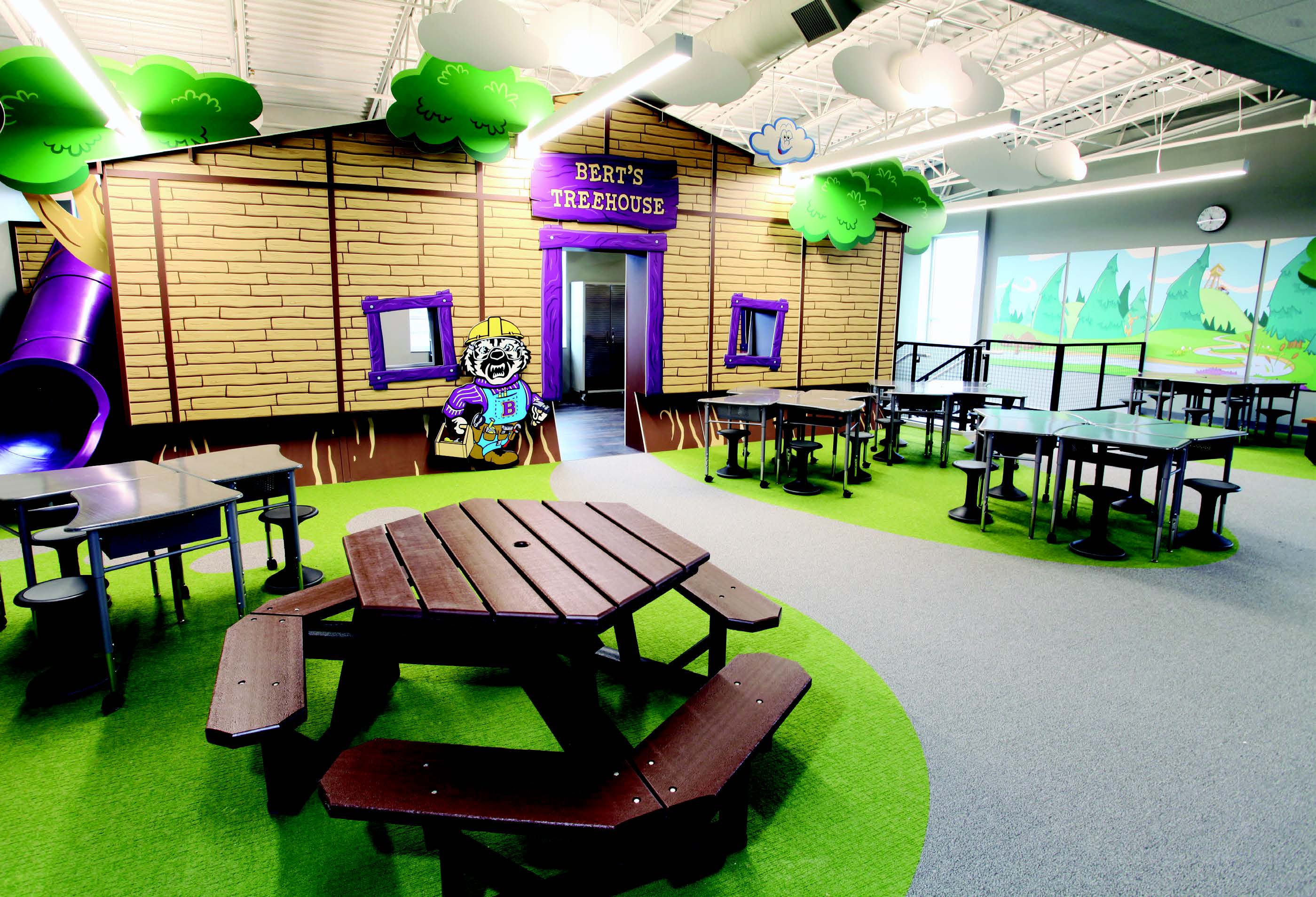 Third and fourth graders enjoy a treehouse theme.
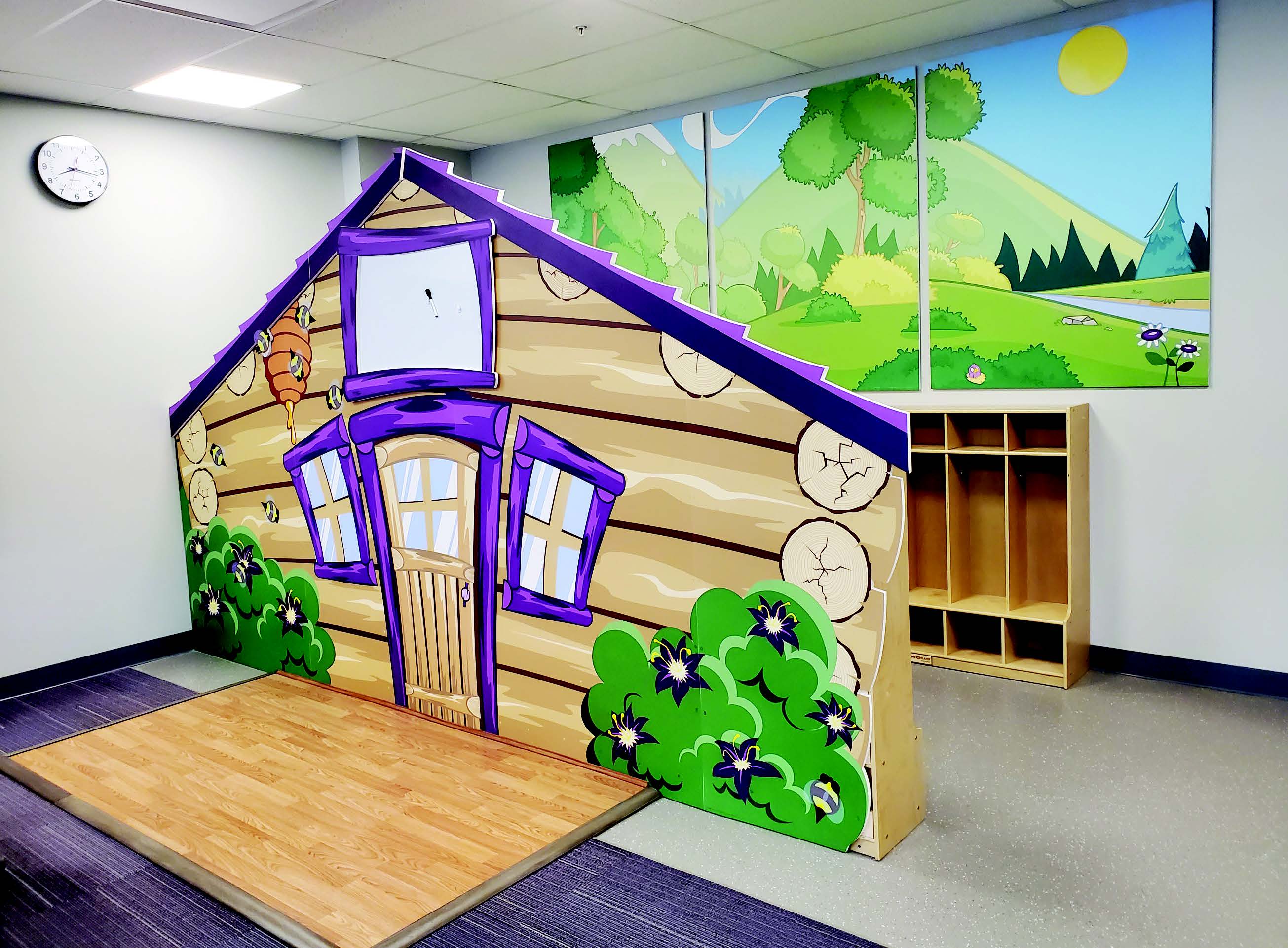 A log cabin welcomes kindergartners to their learning area.
Funding Our Effort
We were in a unique situation because of our expansive rural geography and declining enrollment, which are not atypical of much of rural America. Other districts in the area were also experiencing the same challenges, which is where our journey begins.
Two members of Ohio’s House of Representatives, Representative John Patterson and former Representative Sarah LaTourette, made it possible for us to secure funding. They sponsored two House bills that boosted state funding from an initial Ohio Facilities Construction Commission funding figure of 7% to 45%, and finally to 55%. They put together a House bill that indicated that if two school districts were experiencing declining enrollments, they could combine and the state would contribute a higher amount. We absorbed another school district to make that happen.
We didn’t do this simply to be different; we did it because it aligned perfectly with our project-based learning approach.
Another Ohio House bill provided an additional 10% in funding (to bring our total to 55%) toward building the new school on the site of a college campus. The school was the first in the state to be funded locally by the U.S. Department of Agriculture along with the Ohio Facilities Construction Commission.
Although many bond referenda fail on the first try, voters passed ours by almost a two-to-one margin; however, success came because we were very deliberate about raising support.
For example, we distributed 750–1,000 yard signs supporting the measure. Before our preliminary meetings, we arranged for people we knew to ask the first 5–10 questions, since doing so can often determine the direction a meeting will go.
We also brainstormed responses to many potential objections (such as an increase in taxes) and focused on the value that good schools bring to property values.
More Options for Students and Their Families
One of the most impactful challenges of building a new school is taking the pulse of the community. Going to school in a rural community has its unique challenges, and providing better options was a key component for winning over our students’ families and the business community.
At Berkshire Local Schools, we want our students to achieve the American dream, which we define as a job or career that pays well, offers insurance, and provides an opportunity for advancement. For us, that means going to college, learning a trade, getting specialized training (such as healthcare), joining the military, or following an entrepreneurial path.
District students can enroll in college-credit-plus courses through the adjacent Kent University–Geauga campus and earn an associate degree while they’re still in high school. Because some of the classes are transferable college-level courses, the cost of college can be reduced dramatically.
We also developed a partnership with the University Hospitals health care system. As a result, our students can participate in a new healthcare track with Kent State University and University Hospitals. In addition, the ever-increasing demand for skilled healthcare workers allows students to take classes and become employed in entry-level health care jobs right out of high school.
There was a feeling in our area that schools weren’t doing a good job of exposing students to various trade careers. As a result, a partnership with the Auburn Career Center offers technical schooling for diesel mechanics, which satisfies the demand for training for high-paying trade jobs without requiring a college degree.
Other community partners and donors included the Geauga Growth Partnership, the KeyBank Foundation, and the Great Lakes Cheese Company, which donated $2 million for our outside sports fields.
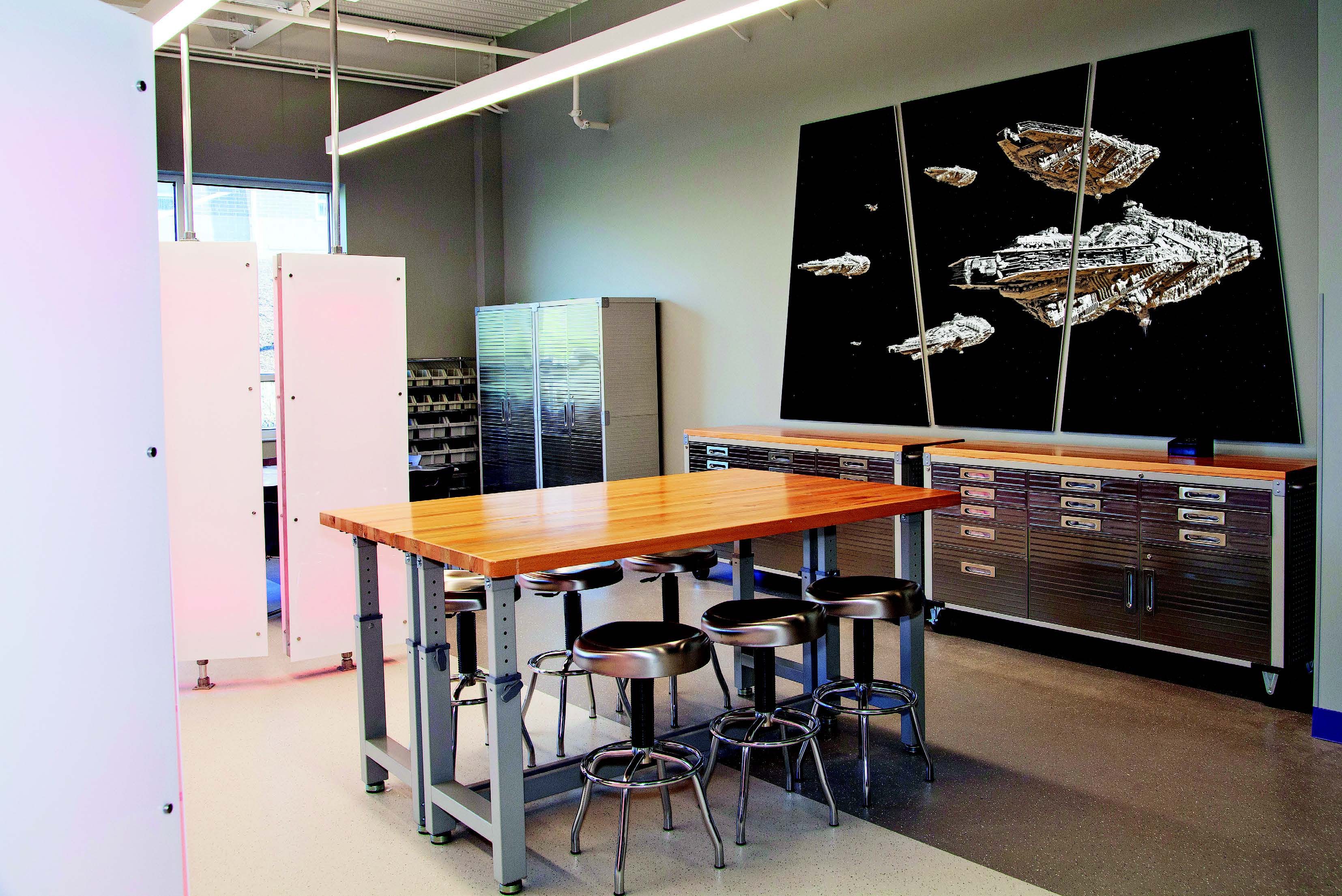 High school students learn in an Innovation Lab.
Supporting Project- Based Learning
Matching the construction of a new school with the learning methodology in place can create a sense of community. Over the past five years, we’ve moved to a project-based learning approach that encourages students to learn and apply what they’ve learned in new ways.
Our school is primarily designed as a large X with separate entrances for PreK, elementary, middle, and high school students; one large dining hall with an expansive kitchen; and a beautiful new 620-seat auditorium, which can be configured for large and small gatherings.
Shortly after I was hired as superintendent, our leadership team toured Inventionland, an immersive work environment and idea incubator in Pittsburgh. One of the most significant invention factories in the world, it has 16 unique spaces where designers work to develop new ideas.
On our way back to Burton after the tour, we asked ourselves, “Why can’t we do something like that?” We think it’s hard to be creative when you’re working out of a beige box classroom all day, so we engaged Inventionland Education to work with us to design and install new learning environments at the end of each wing. These learning spaces include a cabin, pirate ship, tree house, robot room, sci-fi area, and more.
But we didn’t do this simply to be different; we did it because it aligned perfectly with our project-based learning approach. A real bonus was the surprisingly affordable cost.
What I Learned
On reflection, I wish I had hired an owner representative. Our finance team and school board members helped tremendously throughout the process, but we’re not construction experts. I believe the process would have benefited from an owner representative. Other advice I can offer based on my lessons learned include:
Because you will likely face the reality of costs versus your original “wish list,” be ready for value engineering.
Tour area school buildings to see features you like, and ask the administrative staff and teachers what they would have done differently and why.
Be mindful of geographic considerations; for example, a climate with snow and ice requires a pitched roof instead of a flat one.
Build a cushion into your time frame. Completion of the new school was delayed because of supply chain issues and the COVID-19 pandemic; you too will likely encounter problems that require more time.
Have “thick skin.” Even though you have carefully considered options that led you in your direction, people will criticize certain things you’ve done. That, of course, goes with the territory.
Epilogue
Our beautiful 204,000-square-foot campus opened in August 2022 with a ribbon-cutting ceremony that attracted an estimated 2,000 people, more than the entire population of our township. We hope this project will positively affect everyone in our community—students, families, and businesses.
The saying “it takes a village” is very true, and I appreciate everyone who supported us on this amazing journey.