First, Definitions
Time assets are actions or choices made today that will save time in the future. Often, I make myself do things that I don’t particularly want to do at the moment because I know that my “future self” will greatly appreciate the effort and will reap time benefits.
Scheduling interviews and meetings and keeping track of deadlines requires organization and effort; scheduling software is a time asset that creates efficiencies by automating the process. Another example of a time asset is engaging in post-event debriefing to affirm and document the changes that need to be made in subsequent iterations of the activity. In both instances, we pay an upfront investment of time, but we receive a significant payoff afterward.
Time debts are actions or choices made today that will cost additional time in the future. For example, manually entering data in the individual cells of a spreadsheet to calculate a total is not nearly as efficient as entering a dynamic formula. No one in our profession should even think of manually entering individual cell data because it is simply inefficient and takes time away from doing something else.
Time debt often originates from laziness, time pressures, or disorganization, which poses the question, “If I don’t have time to do it right, when will I have time to do it over?”
Some Statistics
Jory Mackay, Rescue Time blogger, interviewed more than 800 people in 2021 and found that:
- More than 90% of the people interviewed regularly worked in the evenings and on weekends.
- The average amount of productive time per day was two hours and 48 minutes.
- Only 5% of the people reported regularly completing the tasks on their to-do lists.
- Workers spent almost 50% of their workday thinking about things other than their work.
These data show that most people are not using the time they have well. This means that they have to work longer hours to “catch up.” To further complicate the situation, few people actually complete the tasks they identified for the day, resulting in unfinished tasks that are then pushed to tomorrow’s list. People then start that day “behind” in their work.
Just like monetary debt, time debt also comes with interest that makes it harder to pay back. The interest comes in the form of focus and attention. The more time we have “loaned” out to other tasks, the more those tasks weigh on our minds and steal our attention.
We can all admit that it is much harder to focus on an upcoming deadline when overdue tasks are nagging at us and tempting us to multitask. We know that multitasking is not truly possible and that every additional task demanding our attention actually diverts 20% of our productive time.
With this said, we can extract ourselves from this never-ending loop and decrease time debt by spending time wisely and building better habits.
Decreasing Time Debts
The key to success is understanding that systems are more important than goals, and time assets are a perfect example of why this is true. Each time asset you create is essentially a system or template that pays dividends. The difficult part comes from having to shift routines from engaging in activities that create time debts to creating those systems that generate time assets. If we are able to do this, we will multiply our time exponentially. A few suggestions follow.
Track how you spend your time. Just as we have to understand our monetary spending in order to create a budget, we need to understand how our time is being spent. Time debt accrues when we are committing more time than we have or we are not using the time we have wisely. With the understanding that gathering this information takes time (which will generate a payoff later), track your time in 15-minute increments for at least two weeks so you will have a comprehensive diary of two week-long cycles to analyze.
Completely rebuild your daily schedule. Now that you know how your time is being used, a complete overhaul of your schedule is in order. Clear out everything except mission-critical tasks, especially reoccurring meetings. Try out the new schedule and identify anything that is broken or inefficient.
One of the difficulties with managing time debt is that many of the things that contribute to it are productive.
Create a time-blocked template for your days. Time blocking consists of each day broken into a set of scheduled work “blocks.” These blocks should be designated for types of work rather than specific tasks. The following categories are examples of blocks that might be appropriate. Keep in mind that the block times should correspond with the times of day that match your energy and productivity cycle.
- Deep work like analyzing or synthesizing data, budget creation, or long-term projects—those tasks that comprise a “core” work product.
- Shallow work like daily/weekly tasks, direct report updates, general correspondence, etc.
- Meetings and emails.
- Breaks throughout the day to maintain high energy levels. Include personal tasks, like eating lunch, going to the gym, and chauffeuring children.
- Buffers between blocks to allow time to prepare for the next obligation.
Be aware of an internal bias called the planning fallacy. This bias accounts for a tendency to be overly optimistic about what can be accomplished in a single day. Be realistic and conservative in your estimates.
Prioritize tasks and meetings. Reintroduce these carefully into your schedule and remember that each one is a time debt. Be hyper-aware of your priorities. If you have difficulty determining what to let back in, try using the Eisenhower Matrix (Figure 1), which is a simple diagram in which you categorize your work on a scale of high to low in terms of the task’s importance and urgency. Focus on those tasks that are highly important and highly urgent.
Pay yourself first. Your ability to properly use your time depends on being healthy and happy. Just as a small business owner might have to prioritize paying himself first to keep his family healthy, so you should pay yourself first by setting aside time to rest and recharge. Take some of the time you have saved to do something meaningful for yourself.
Remove energy drains and incomplete items. One of the difficulties with managing time debt is that many of the things that contribute to it are productive. Creative coach Tina Essmaker, in her November 2019 Behance blog, calls these “drains and incompletions.”
- Drains are tasks we have to do and cannot remove from our day. Examples include commutes, phone calls, emails, and unanticipated crises.
- Incompletions are those tasks that are small enough that they do not become items on our task list, such as conversations we need to have, organizational tasks to be done, or supply orders.
Drains and incompletions can divert our attention and create inefficiencies. In order to mitigate these issues, try the following:
- Set aside a few minutes every day to write down every drain and incompletion you can identify.
- Cross off anything on your list that you cannot control.
- Create an action plan for the rest of your list. For incompletions, this might mean delegating tasks, not procrastinating and just doing it, or finding the resources you need.
Protect your system. Now that you have a system in place, you must be diligent in protecting it. A good place to start is by setting your priorities and choosing how to spend your time with your colleagues. Consider limiting your time spent on drains, setting clear boundaries on your availability, or shifting the way you use your time. As a part of this process, you will have to decline requests that are not strategically important.
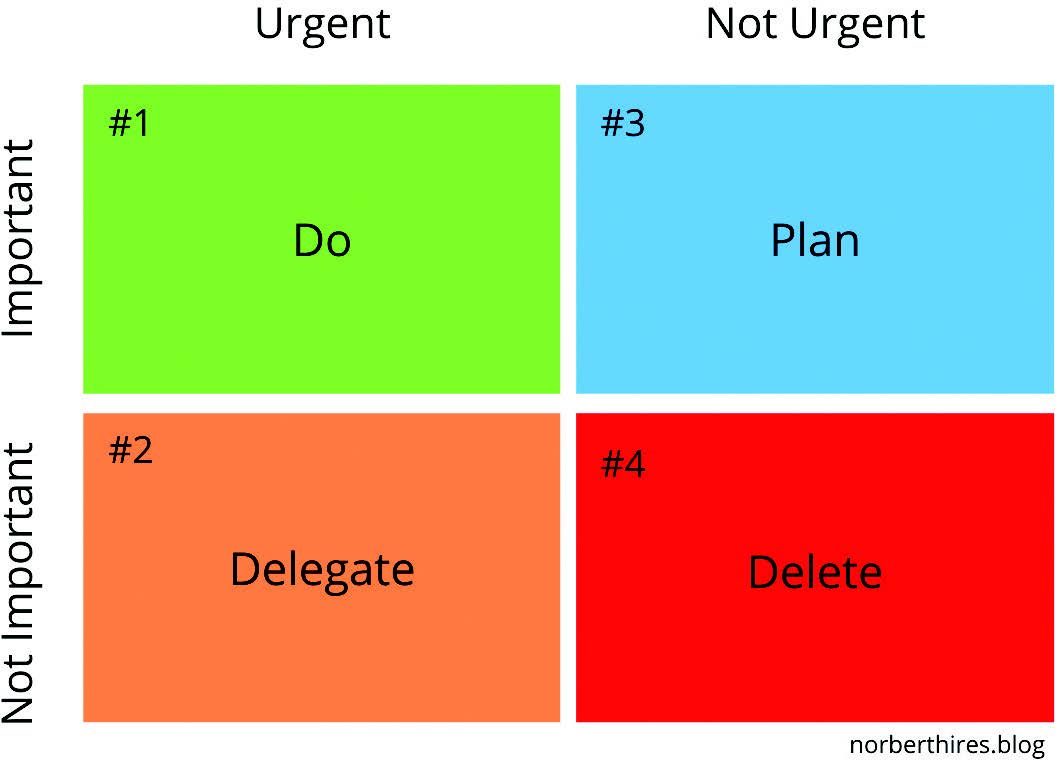 Figure 1. The Eisenhower Matrix
Increasing Time Assets
Now that you are out of time debt, the next step is ensuring that you are creating time assets. There are a few ways to start this process.
- Use time multipliers. These are simple tools or workflows that give a compound return on time invested. Some examples include carefully prioritizing a to-do list and optimizing organizational systems and work environment.
- Single task. Focused hours can be significantly more productive than hours with split attention. It is critical to learn how to focus on a single task while also minimizing distractions to maximize productivity.
- Delegating tasks. Research has shown that most knowledgeable workers spend about 41% of their time on tasks they could easily delegate to others. Bear in mind that research shows that even if it takes 30 times as long to train someone else, we will reap more than 500% return on our investment of time.
This means that we will create a time asset by training people and then delegating tasks to them.
- Create a communication plan. Email, calls, and texts might feel productive but can be the source of tremendous time debt. Take the time to set boundaries and guidelines about when you are available, how to best communicate with you, and set expectations for the time it might take you to respond. For example, during the school day, employees know that I prefer to be reached by text and that I will only read email after 5:00 pm.
- Create a distraction-free environment when you need to focus. When blocking out calendar time for major tasks, consider workspace to ensure that you are able to focus exclusively on the task at hand.
Thinking about time debts and time assets is a different way to consider the nuances of time management. It is just another tool in our arsenal to combat the ever-increasing demands on our time. There is an initial time debt to enact these strategies; nevertheless, remember that the actions and choices we make today have a compounding impact on how much time we have in the future.
If we make careful choices today, our future selves will appreciate our attention to detail and efficiency, and we will be rewarded with leisure time to do the things that make us happy.