For Platte County, the shift to a four-day week could be the incentive that leveraged us into the labor market. The decision, however, was based on the answers to the following questions:
- What are the implications for student achievement?
- Will it save the district money in the long run?
- How will the community respond?
- And perhaps most important, will we lose students because of the transition?
With so many questions to answer, we had to remind ourselves that we were not inventing the wheel; we could look to several of our nearest neighbors who had hopped on the four-day week bus long before we took the leap.
It was immediately apparent that districts with a four-day model had better recruiting and staff retention.
A community survey—which reaped hundreds of emails and dozens of phone calls, combined with a study of the calendars of several districts with a four-day model—brought a number of key elements to light. It was immediately apparent that districts with a four-day model had better recruiting and staff retention.
Taking the Plunge
Platte Canyon’s 2023–2024 school year was its first on a four-day model; it was also the first time in the six years I have been with the district that we started the school year almost fully staffed. Only one vacancy was unfilled when students walked through our doors on August 9. Even though we reduced the employee annual work calendars by 10% to 12%, reducing the hours per week across the district, we did not reduce pay for anyone already on staff. That allowed us to increase base hourly wages for all positions.
The final consideration was one that holds great importance among the current generation of educators and support staff: better life balance. Better life balance means more time at home with family, more time to refuel and refresh between workweeks, and an overall better quality of life.
The longer days of a four-day week are an adjustment for both students and staff. But overall, the feedback from students, parents, and staff indicates that the extra day off outweighs the slightly longer school days. In addition to the savings on fuel for buses and commuting staff, the four-day week may reduce the impact of snow closures on school days.
Addressing Challenges
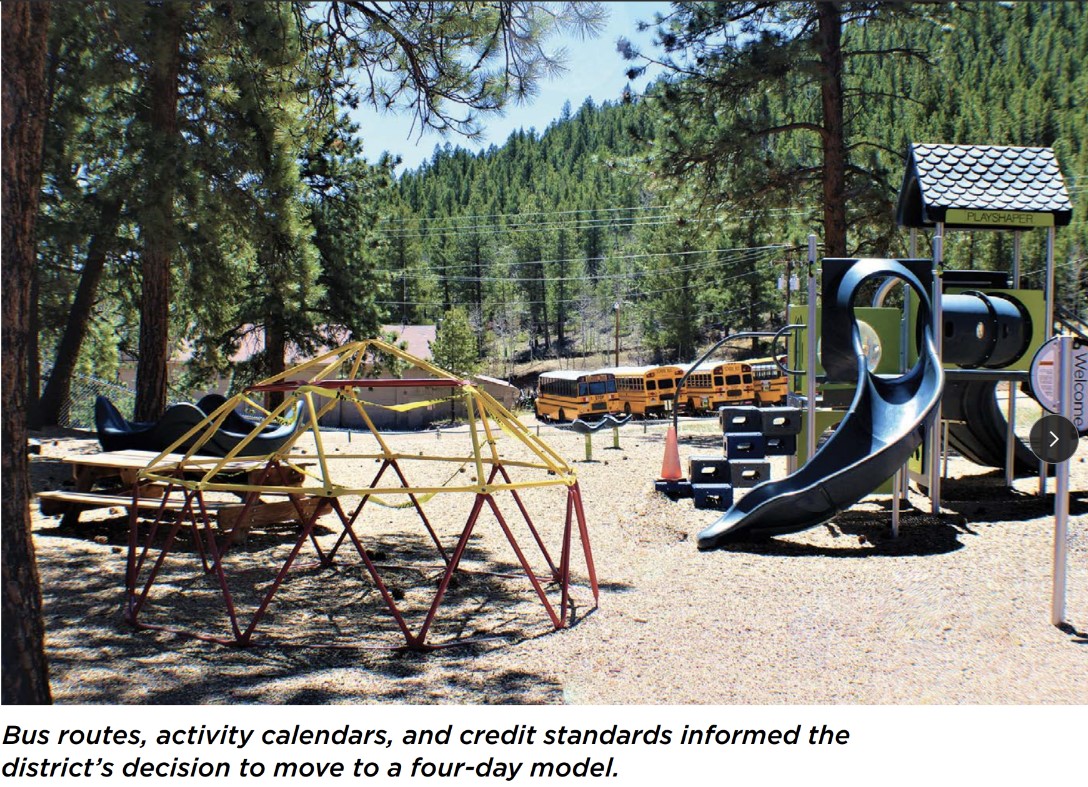
The school board’s unanimous decision to shift to a four-day week turned out to be the easy part. Hours of reflecting on student schedules in order to maintain credit standards and Carnegie hours began. Then came reviewing bus routes and student activity calendars to ensure that students weren’t getting home too late and that academic minutes were maintained for the school year, followed by planning for support services for students and families who relied on the district for Friday assistance.
And finally, it was necessary to rework employee and staff calendars and days, rewriting the definition of “full-time equivalent” and trying to make all these changes equitable for the entire staff.
The transition was a huge achievement for all our departments, and some kinks remain to work through.
We will continue to work on our schedule and calendar to best fit our community and staff. Settling into the new model will take time; but overall, our employees, students, and families report that we made the right move.
I can speak from personal experience when I say that having one more day to spend with my family, to enjoy our Colorado outdoor lifestyle, and to grow closer and learn in the home environment has had a positive effect.
A common theme coming from other four-day districts is that there are always concerns in the beginning and communities can be skeptical of the change, but once you have made the switch, your community will never choose to go back!