During the July 9 Hill Day, attendees also shared concerns with their elected officials about three critical K–12 funding issues:
• The delayed release of FY25 federal funds for the 2025–26 school year
• How the One Big Beautiful Bill Act (OBBA) would affect states, schools, and families,
• Why strong investments in education are needed now more than ever as Congress works on FY26 appropriations.
FY25 Federal Funding Delays Cause K–12 Budget Uncertainty Nationwide
In March, Congress passed a spending law that flat-funded education and other programs for federal FY25, which affects funding for the 2025–26 school year. However, a day before federal funding was expected to be released to states and schools, the U.S. Department of Education (USED) announced that nearly $6 billion in Title funding — for programs I-C, II-A, III-A, IV-A, and IV-B — wouldn’t be released on schedule due to a “programmatic review.”
This unprecedented delay left school districts in limbo, unable to finalize their budgets for the upcoming year and scrambling to fill budget gaps if federal funding wouldn’t be released anytime soon.
ASBO International led two Hill groups and met with 14 Senate offices from WA, WI, PA, CA, TX, NC, and OH to discuss the impact of these funding delays. The groups included members of ASBO International’s Board, Legislative Advisory Committee (LAC), and state affiliates. Several LAC members also met with House and Senate offices from TX, OH, NY, and MO on their own.
ASBO International remains committed to advocating for robust, predictable federal funding that empowers school districts to meet the diverse needs of their students.
Members expressed concern about the funding delays, noting how it was forcing district leaders to make difficult choices to lay off or postpone hiring new teachers and staff, terminate vendor contracts, cancel summer programming and tutoring services for students, scale back services for English learners, and more. Delaying and cancelling federal funding disrupted the stability of educational programs that schools, students, and communities rely on.
Two weeks after Hill Day, Title IV-B funding was released, and another week later, USED announced all funds had been released. While we are pleased to see this positive outcome from our advocacy efforts, we are concerned about the lack of stability and predictability in federal education funding and will oppose any attempts to rescind or destabilize it in the future.
Medicaid & SNAP Cuts Would Also Mean Cuts for States and Schools
Many ASBO members discussed how changes to SNAP and Medicaid that were recently passed in the OBBBA would negatively affect future state and school budgets. Direct cuts and technical changes to program eligibility, work requirements, state verification processes, and other provisions would strain state budgets, putting K–12 funding at risk and further limiting programs and services that support student and community needs.
For Medicaid, members highlighted how funds were currently being used in schools, including to supplement critical staff and services to support students with disabilities. They told personal stories about what funding cuts would mean for their students, and ASBO International shared a recent School Medicaid report co-published with AASA and the Healthy Schools Campaign. Several offices were unaware of how much districts relied on Medicaid funding and wanted to learn more about the issue.
As for SNAP, ASBO members shared concerns about how new programmatic changes would make fewer families eligible for SNAP, which would cause more children to come to school hungry. With fewer families qualifying for Medicaid and SNAP, this would negatively impact direct certification, which allows districts to automatically enroll eligible students to receive free school meals.
ASBO members also opposed the new federal private voucher tax credit recently enacted in the OBBBA for diverting federal taxpayer dollars to private schools. The program would start in 2027 and offer a dollar-for-dollar tax credit to filers who donate to scholarship-granting organizations (SGOs) that provide scholarships to help students attend private schools.
We urged offices to ensure the program is carefully regulated by the Treasury Department and by states that choose to opt into the program. Given the anticipated negative effects that the OBBBA will have on schools, we asked lawmakers to show their support and provide strong funding for education in FY26.
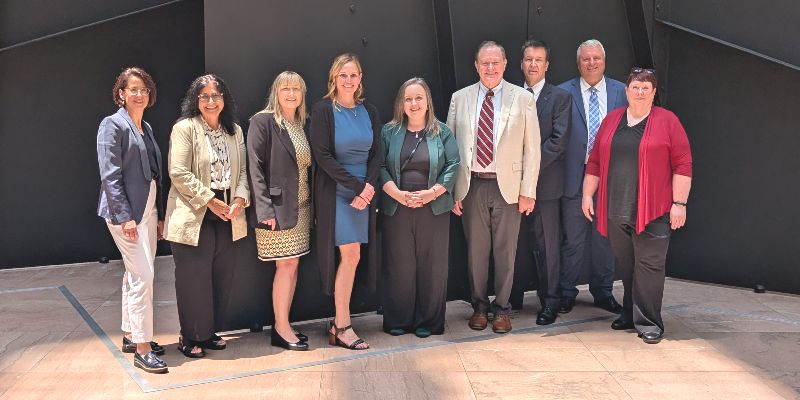 Several members of ASBO’s Legislative Advisory Committee & Board gather in the Senate Hart building for Hill meetings on July 9, 2025.
Top Priority for FY26: Protect Education from Harmful Cuts
Deliberations over FY26 appropriations have been delayed due to Congress’s focus on budget reconciliation. However, in late May, the President released a FY26 budget proposal calling for a 15% cut to the Department of Education. While Title I and IDEA funding would be protected, the budget proposed a new “K–2 Simplified Funding Program,” consolidating 18 K–12 programs into a block grant. These programs were funded at $6.5 billion in FY24, but the budget proposal would cut these programs by $4.5 billion into a single $2 billion block grant.
The budget also proposed eliminating Title I-C, Title III, and several other programs. As for special education, the budget proposed a different block grant, which would increase IDEA Part B by $677 million but eliminate funding for other IDEA programs, leaving overall special education funding flat.
ASBO International members told Hill representatives that while we appreciate proposals to increase local flexibility and decision-making for spending federal funds, we couldn’t support any measure that would significantly cut critical resources for public schools and students.
Three weeks after Hill Day, the Senate passed its Labor, Health and Human Services, and Education (L-HHS-ED) appropriations proposal through committee, and we were pleased to see small increases for IDEA, Title I, and rural education, and relatively flat funding for most other K–12 programs.
Given the current climate and the President’s alternative proposal in the FY26 budget, we consider the Senate’s bill an advocacy win. The Senate bill also included language to ensure future federal education funding is released on time to avoid the situation we faced with FY25 in the future. We won’t know the House’s proposal until they take up their bill in September.
Your Voice Matters. Our Advocacy Matters.
ASBO International remains committed to advocating for robust, predictable federal funding that empowers school districts to meet the diverse needs of their students. We encourage members to share their stories about how federal funding supports students and school communities. Policymakers need to hear from you! Now is an opportune time to reach out while Congress is on recess and working from their local offices.
If you have questions about ASBO International’s advocacy priorities, the AASA/ASBO Legislative Conference, or connecting with your elected officials, please don’t hesitate to contact us. We are here to support you!
Save the date and plan to join us at next year’s Legislative Advocacy Conference, July 7–9, in Washington, D.C.