“Beyond the value of year-round training, indoor practice facilities offer better turf quality, controlled environments and predictable field sizes compared to outdoor fields,” says Brad Curtis, president of Tyler Building Systems of Tyler, Texas. “Having indoor practice facilities for high school sports, drill teams, and cheer squads has become increasingly common and sought after across Texas in recent decades, with over 200 such facilities already constructed.”
Using metal building technology made it easier to synchronize construction while achieving the bank’s attendance requirements.
Versatile Choice
A case in point is the Lindale High School multipurpose activity center (MAC) in Lindale, Texas. The mechanically lowered divider net and retractable cages inside the IPF enable multiple groups to practice simultaneously, optimizing the use of space. The energy-efficient design, with its insulation and natural lighting creates a comfortable and engaging environment for student athletes — all while contributing to cost savings for the district.
Lindale head baseball coach Rich Sanguinetti calls the MAC "a blessing" to the school district. "It is our only turf field option on campus, so it gets used every single day during the school athletic period. Its versatility allows any sport, cheer, drill team or band to get out there and practice.
"The MAC has allowed us to not miss a practice due to inclement weather in four years," he adds. "Those reps add up over time and our athletes see a huge benefit from being able to go in there and get real practice in."
Chris Cochran, the school’s head football coach and athletic director concurs. "Our indoor facility has been a game changer for our athletic programs," he says. "We have gotten so much use out of it. It has been a huge advantage for all of our teams, along with our band and drill team. There is enough space in it that, during the bad weather days in the spring, we can get four different teams in it at one time if we need to.
"During the fall, we are able to rotate from our freshman football team to the JV and varsity football teams to our full marching band—all in one afternoon/evening. That is around 300-350 students. We also use it during multiple class periods throughout the school day," he says.
In North Texas, another prime IPF is the award-winning Melissa Championship Center, a $21.3-million, 134,200-square-foot facility on the Melissa Independent School District’s high school campus. The facility provides a practice venue for football, baseball, soccer and band performances. The column-free building houses an indoor turf field, an eight-lane competition track and a football/soccer field. Amenities include nine locker rooms; weight, training and wrestling rooms; VIP meeting spaces; and theater-style classrooms. Nets, cages and platforms descend from the ceiling.
"Thee structure is larger than some of the state’s college-level facilities,” says Darrell Geisendorff, vice president of sales and marketing with Red Dot Buildings of Athens, Texas, which supplied the metal building system for this project.
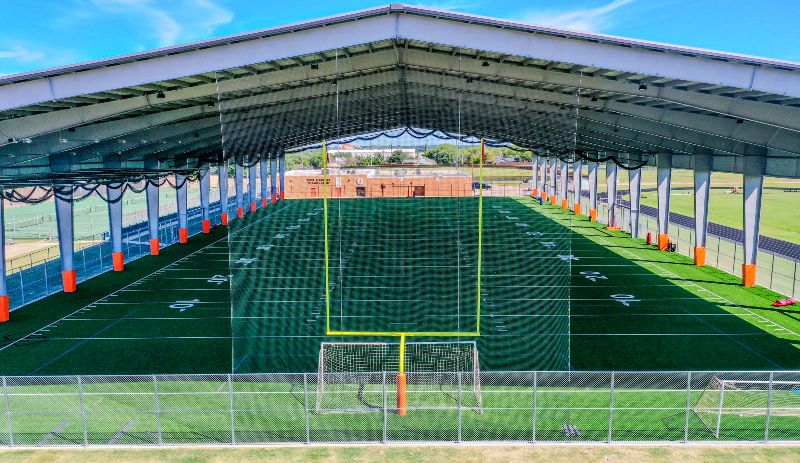
Photo by Tyler Bush
Image 2:All five schools in Mesquite, Texas, are installing indoor shade structures to reduce field temperatures by 20 to 25 degrees.
A Shading Option
While indoor practice facilities are an ideal training solution, the cost is prohibitive for many school districts nationwide. When IPFs are out of reach, some districts are installing shade structures, such as those at all five high schools in Mesquite, Texas. “The school district purports that the shade structures have reduced field temperatures by 20 to 25 degrees,” says Jason Montes, director of marketing with Red Dot Buildings.
The structures incorporate skirt walls to provide additional shaded areas for activities, casting protective shadows onto the field. These skirt walls allow indirect sunlight to enter while still shielding occupants from blowing wind and rain, creating a more comfortable and protected environment.
In addition, the pavilions are designed with elevated X-bracing that does not extend to the field level. By keeping the wind bracing higher above the ground, the design avoids obstructing the movement of students and staff as they enter and exit the bays, ensuring both safety and ease of access.
"At the end of the day, it's all about peace of mind,” Geisendorff says. “These pavilions provide reliable protection, smart design and the kind of durability schools districts can count on in every season.”